


Global Gyroscope Market Outlook 2031: Rising Smartphone Demand, MEMS Innovation, and Expanding Aerospace Applications to Drive Growth at 5.2% CAGR
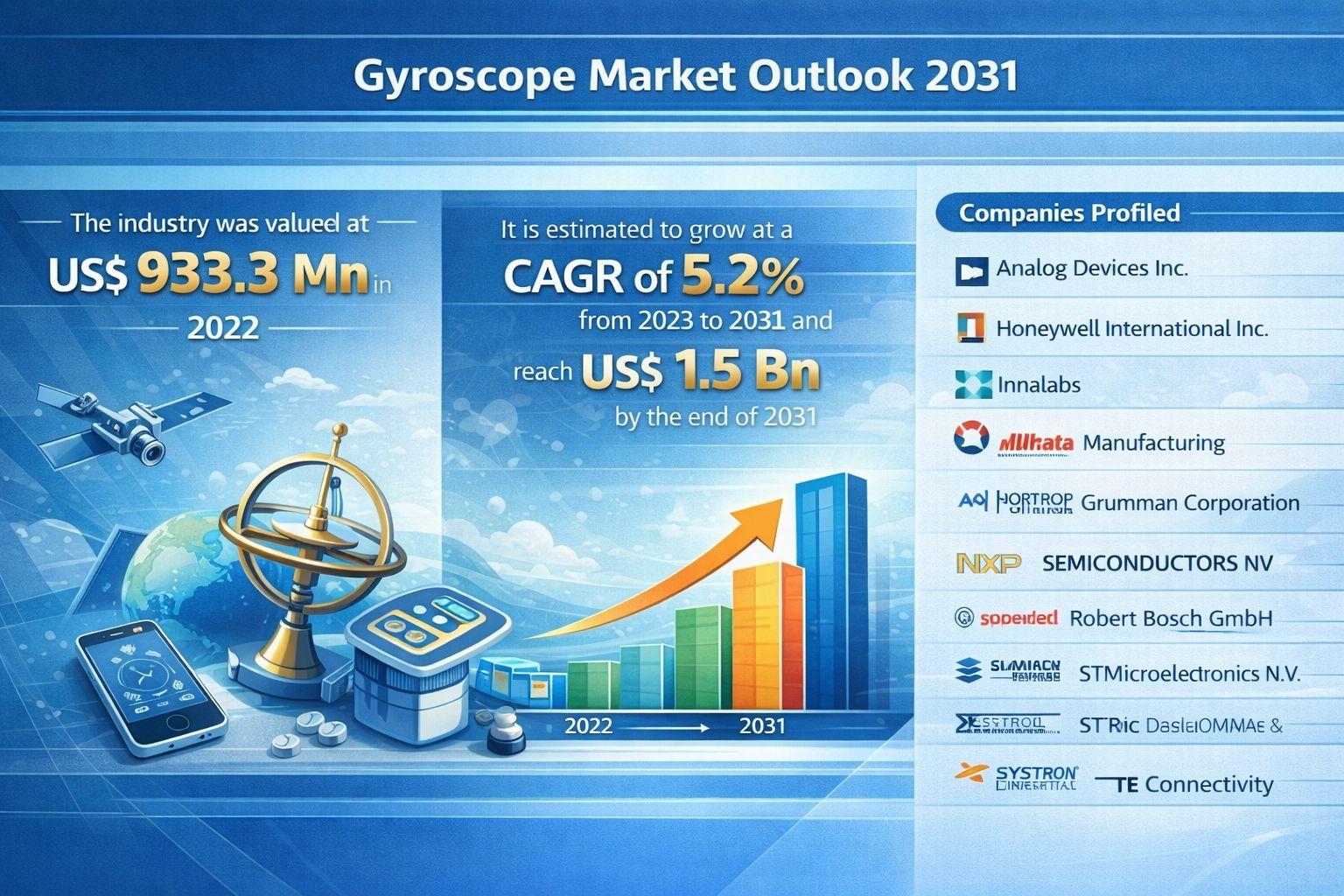
The global gyroscope market is witnessing steady growth, fueled by rapid advancements in sensor technologies, increasing integration of smart devices, and expanding applications across industries such as aerospace & defense, automotive, and consumer electronics. Valued at US$ 933.3 Mn in 2022, the market is projected to reach US$ 1.5 Bn by 2031, growing at a CAGR of 5.2% during the forecast period (2023–2031).
Gyroscopes, once primarily associated with aviation and navigation systems, have now become integral to modern electronic ecosystems. From smartphones and wearable devices to autonomous vehicles and industrial automation systems, gyroscopes play a critical role in enabling motion sensing, orientation detection, and stabilization.
Analyst Viewpoint
The increasing demand for smartphones and the miniaturization of inertial sensors are among the primary drivers shaping the gyroscope market. As consumer electronics continue to evolve with enhanced features such as augmented reality (AR), virtual reality (VR), and advanced gaming, the integration of gyroscopes has become essential.
Additionally, the rising adoption of Unmanned Aerial Vehicles (UAVs), electronic stability control systems in vehicles, and precision navigation technologies is further accelerating demand. Technological advancements, particularly in Microelectromechanical Systems (MEMS), are enabling the development of compact, cost-effective, and highly accurate gyroscopes.
Leading players such as Honeywell International Inc. and STMicroelectronics N.V. are investing heavily in research & development, partnerships, and product innovation to strengthen their market position.
Market Overview
Gyroscopes are essential components in navigation and stabilization systems used in aircraft, UAVs, and defense equipment. They provide precise orientation and angular velocity data, ensuring accurate motion sensing in dynamic environments.
In consumer electronics, gyroscopes are part of Inertial Measurement Units (IMUs), which enable functionalities such as step counting, gesture recognition, and image stabilization. The integration of IMUs into smartphones has revolutionized user experiences, making them indispensable in modern devices.
Advancements in MEMS technology have significantly reduced the size, cost, and power consumption of gyroscopes. This has enabled their widespread adoption across high-end, mid-range, and even budget smartphones.
Key Market Drivers
Increase in Demand for Smartphones
The evolution of smartphones from basic communication devices to multifunctional smart systems has significantly boosted the demand for gyroscopes. Modern smartphones support applications such as navigation, gaming, video conferencing, and AR/VR experiences, all of which rely heavily on motion sensing technologies.
The growing penetration of 5G-enabled smartphones is further accelerating this trend. With global adoption rates increasing rapidly, particularly in countries like China and India, the demand for advanced sensors, including gyroscopes, is expected to rise substantially.
Moreover, the emergence of foldable smartphones and the expansion of low-cost smartphone markets in developing regions are contributing to sustained market growth.
Miniaturization of Inertial Sensors
Miniaturization is a key trend transforming the gyroscope market. MEMS technology allows manufacturers to produce smaller, more efficient, and cost-effective inertial sensors without compromising performance.
Companies such as TDK Corporation are developing advanced miniaturized sensors like the AXO215, which offer high accuracy and reliability even in harsh environments.
The ability to integrate these compact sensors into a wide range of devices—from smartphones to industrial equipment—has opened new avenues for market expansion. Miniaturized IMUs are now widely used in applications beyond navigation, including robotics, healthcare devices, and IoT systems.
High Demand for MEMS Gyroscopes
MEMS gyroscopes dominated the market with a 48.6% share in 2022 and are expected to maintain their leadership throughout the forecast period. Their popularity stems from their compact size, low cost, and high performance.
The increasing adoption of MEMS gyroscopes in consumer electronics, automotive safety systems, and industrial automation is driving segment growth. In March 2023, TDK Corporation introduced the Tronics GYPRO 4300, a high-performance MEMS gyroscope designed for dynamic applications such as UAVs, railway systems, and marine equipment.
Such innovations are expected to create lucrative opportunities for manufacturers and technology providers in the coming years.
Extensive Use in Consumer Electronics
The consumer electronics segment accounted for 31.7% of the market share in 2022 and is projected to grow at a CAGR of 5.7%. Gyroscopes are widely used in smartphones, tablets, gaming consoles, and wearable devices to enable features such as:
- Motion tracking for gaming
- Augmented and virtual reality experiences
- Gesture recognition
- Camera image stabilization
The surge in demand for feature-rich smartphones is a key factor driving this segment. For instance, India recorded smartphone shipments of approximately 173 million units in 2021, highlighting the massive scale of consumer electronics adoption.
Regional Outlook
Asia Pacific – The Dominant Market
Asia Pacific held the largest market share of 56.3% in 2022, driven by strong manufacturing capabilities and high consumer demand. Countries such as China, Japan, South Korea, and India are major hubs for electronics production and consumption.
The rapid expansion of the consumer electronics industry, coupled with increasing adoption of smartphones, wearables, and gaming devices, is fueling demand for gyroscopes in the region.
North America – Strong in Aerospace & Defense
North America accounted for 19.1% of the market share in 2022, supported by its well-established aerospace and defense sector. Gyroscopes are extensively used in aircraft navigation systems, satellites, and military equipment.
The presence of major players such as Northrop Grumman Corporation and continued investments in advanced defense technologies are contributing to market growth in the region.
Competitive Landscape
The global gyroscope market is highly fragmented, with numerous players competing through innovation, strategic collaborations, and mergers & acquisitions. Key companies include:
- Analog Devices Inc.
- Honeywell International Inc.
- Murata Manufacturing
- Robert Bosch GmbH
- STMicroelectronics N.V.
- TE Connectivity
These companies are focusing on expanding their product portfolios and enhancing their technological capabilities to gain a competitive edge.
Key Developments
Recent developments highlight the pace of innovation in the market:
- In December 2022, Honeywell International Inc. delivered its one-millionth tactical-grade IMU, widely used in UAVs and military systems.
- In November 2022, Murata Manufacturing launched the SCC400T MEMS gyroscope sensor, offering superior stability and noise performance for demanding applications.
These advancements underscore the growing emphasis on precision, reliability, and performance in gyroscope technologies.
Market Segmentation
The gyroscope market can be segmented based on:
Type:
MEMS Gyroscope, Fiber Optic Gyroscope, Ring Laser Gyroscope, Dynamically Tuned Gyroscope (DTG), Others
Dimension:
1-Axis, 2-Axis, 3-Axis
End-use Industry:
Automotive & Transportation, Consumer Electronics, Aerospace & Defense, Industrial, Healthcare, Others
Regions:
North America, South America, Europe, Asia Pacific, Middle East & Africa
Future Outlook
The future of the gyroscope market looks promising, driven by continuous technological innovation and expanding application areas. The integration of gyroscopes into emerging technologies such as autonomous vehicles, smart wearables, robotics, and IoT devices is expected to unlock new growth opportunities.
Furthermore, advancements in MEMS technology will continue to enhance sensor performance while reducing costs, making gyroscopes more accessible across industries.
As industries increasingly rely on precise motion sensing and navigation capabilities, the demand for gyroscopes is set to grow steadily. With strong support from consumer electronics, aerospace, and automotive sectors, the global gyroscope market is well-positioned to achieve sustained growth through 2031.
Categories
Read More
"Executive Summary Lanolin Market Size and Share Forecast Data Bridge Market Research analyses that the lanolin market which was USD 418.7 million in 2022, would rocket up to USD 635.30 million by 2030, and is expected to undergo a CAGR of 5.35% during the forecast period. This Lanolin Market research report is a great resource that makes available current as well as upcoming...
" Sports Apparel Market Summary: According to the latest report published by Data Bridge Market Research, the Sports Apparel Market The global sports apparel market size was valued at USD 213.31 billion in 2024 and is expected to reach USD 328.12 billion by 2032, at a CAGR of 5.53% during the forecast period An influential Sports Apparel Market...

Most university students think they are prepared for thesis writing until they actually begin working on it. That is usually when the pressure starts building. A thesis is completely different from normal assignments. It is longer, more detailed, and honestly far more mentally exhausting than many students expect. I remember talking to a student in the UK who said her thesis became stressful...

The internet connects us to everything — work, entertainment, shopping, and communication. But with convenience comes vulnerability. Cyber threats, data collection, and surveillance have become common concerns for anyone going online. While some believe privacy tools are expensive, the truth is you don’t need to spend a fortune to protect your digital life. A cheap VPN can offer...

According to the latest report published by Data Bridge Market Research, the In Vitro Diagnostics (IVD) Market CAGR Value The large scale In Vitro Diagnostics (IVD) Market report comprises of historic data along with future forecast and detailed market analysis on a global, local and regional level for In Vitro Diagnostics (IVD) Market industry. The report helps out in...