


How to Choose the Right Generative Engine Optimization (GEO) Agency in 2026
The way people discover information online has fundamentally changed. Traditional search engines are no longer the only gateway to answers—AI-powered platforms like ChatGPT, Google AI Overviews, Perplexity, and Gemini now synthesize responses directly, often without requiring users to click through to websites.
This shift has introduced a new discipline: Generative Engine Optimization (GEO). And with it comes a new challenge for businesses—how to choose the right GEO agency.

This guide breaks down what GEO is, how it differs from SEO, and how to evaluate agencies in this rapidly evolving landscape.
The Shift to AI Search: Why GEO Matters
AI search is changing how visibility works online. Instead of ranking links, AI systems generate answers by pulling from multiple sources. In fact, studies show that a large percentage of searches now end without a click, and organic traffic patterns are becoming less predictable.
This means brands must optimize not just for rankings, but for inclusion in AI-generated answers.
GEO focuses on ensuring that your brand is:
- Recognized as a credible entity
- Referenced in AI-generated responses
- Structured in a way that machines can easily interpret
SEO vs GEO vs AEO: Understanding the Difference
Before choosing a GEO agency, it’s critical to understand how GEO fits within the broader search ecosystem.
SEO (Search Engine Optimization)
SEO focuses on optimizing content and technical infrastructure—like site speed, backlinks, and keywords—to rank in traditional search engines.
Goal: Rank in the top positions on search engine results pages.
GEO (Generative Engine Optimization)
GEO extends SEO into AI-driven environments. It focuses on entity clarity, citations, and structured data so AI systems can reference your brand.
Goal: Be cited in AI-generated answers.
AEO (Answer Engine Optimization)
AEO emphasizes structuring content so it can be directly extracted as answers by AI systems and voice assistants.
Goal: Provide the exact answer to a user’s query.
In practice, these three disciplines work together. GEO without AEO limits extractability, and AEO without SEO lacks discoverability. The best agencies integrate all three.
Why Choosing a GEO Agency Is Different
The criteria for evaluating agencies has changed significantly due to AI search.
1. Measurement Is Harder
Traditional SEO metrics like rankings and traffic are no longer enough. GEO requires tracking:
- Citation frequency in AI responses
- Entity salience
- Downstream conversions from AI referrals
Many agencies are not yet equipped to measure these effectively.
2. The Discipline Is New
GEO is still evolving. What worked a year ago may already be outdated. Experience matters less than adaptability and understanding of AI systems.
3. The Risk of Mistakes Is Higher
Low-quality signals or poorly structured content can lead to long-term visibility issues in AI systems, which are harder to fix than traditional SEO errors.
Core Services a GEO Agency Should Provide
A strong GEO agency goes beyond content creation. It builds a comprehensive system for AI visibility.
AI Visibility Strategy and Citation Research
Agencies should map the AI landscape:
- Identify prompts users ask
- Analyze which brands are cited
- Establish a baseline for your visibility
This ensures efforts are focused on meaningful citation growth.
Technical Foundation: Schema and Entity Structuring
Technical SEO is still critical. Agencies must:
- Implement structured data (schema markup)
- Define entities clearly across platforms
- Ensure crawlability and indexing
Without this foundation, AI systems cannot reliably interpret your content.
AEO-Optimized Content Creation
Content must be structured for AI extraction:
- Direct answers to specific questions
- FAQ frameworks
- Clear headings and formatting
This increases the likelihood of being included in AI-generated responses.
Digital PR and Authority Building
AI systems prioritize authoritative sources. Effective GEO requires:
- Mentions in credible publications
- Citations in trusted databases
- Consistent brand representation
Quality matters more than volume.
Integration with Traditional SEO
GEO does not replace SEO. It builds on it. Agencies must ensure:
- Strong technical SEO
- Mobile performance
- Domain authority
Without these, GEO efforts lack stability.
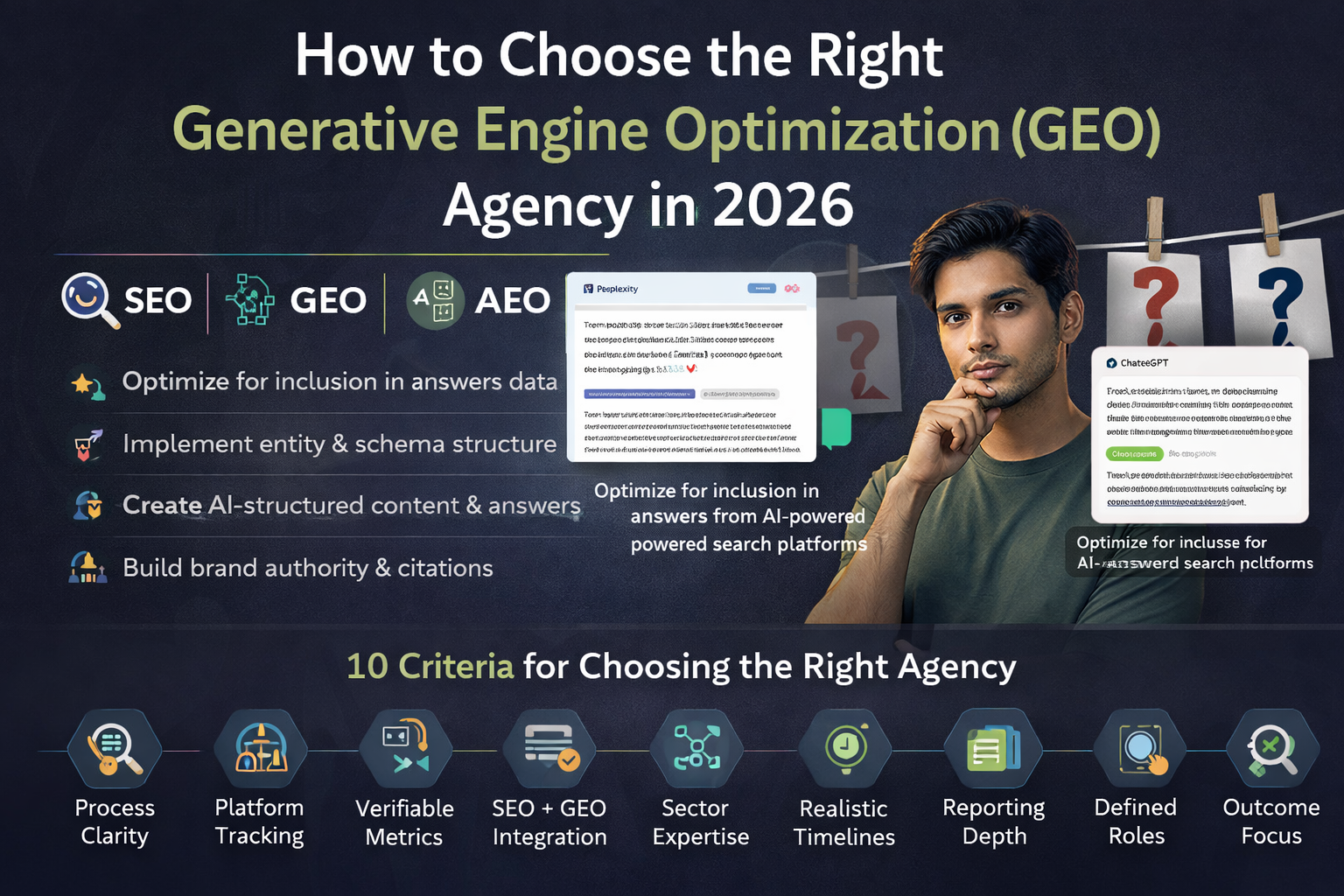
10 Criteria for Evaluating a GEO Agency
When hiring a GEO agency, look beyond surface-level claims. The document outlines ten critical evaluation criteria:
1. Operational Clarity
Can the agency clearly explain how entity signals translate into AI citations?
2. Platform Tracking
Do they track performance across platforms like ChatGPT, Perplexity, and Google AI separately?
3. Verifiable Metrics
Do they provide baseline citation data and measurable growth?
4. SEO + GEO Integration
Can they audit both technical SEO and GEO simultaneously?
5. Sector Expertise
Do they understand your industry’s nuances and compliance requirements?
6. Realistic Timelines
Are they transparent about expected results (e.g., gradual growth over months)?
7. Reporting Depth
Do reports explain why metrics change and what actions follow?
8. Defined Roles
Is there a clear division between strategy (client) and execution (agency)?
9. Contract Flexibility
Do they offer pilot periods or milestone-based engagement?
10. Outcome Focus
Do they track business outcomes like conversions, not just citation counts?
Red flags include vague promises, guaranteed placements, and generic dashboards.
What to Expect from a Top-Tier GEO Partner
High-quality GEO agencies demonstrate specific capabilities:
- AI Benchmarking: Establishing where your brand stands in AI responses
- Platform-Level Reporting: Tracking performance across different AI systems
- Verifiable Case Studies: Showing measurable citation growth and outcomes
- Integrated Execution: Combining technical SEO and content strategy
- Realistic Expectations: Focusing on long-term authority, not quick wins
They avoid guarantees and instead emphasize process and measurement.
How GEO Work Actually Happens: The Three-Phase Model
The document outlines a practical framework for GEO implementation:
Phase 1: Audit and Foundation (0–3 Months)
- Technical audit
- Entity gap analysis
- Baseline measurement
Outcome: A clear roadmap for improvement.
Phase 2: Build and Scale (3–6 Months)
- Content production
- Digital PR campaigns
- Initial citation growth
Outcome: Visibility begins to increase.
Phase 3: Optimize and Expand (6+ Months)
- Refinement based on AI behavior
- Expansion into new categories
- Authority compounding
Outcome: Sustained growth and stronger AI presence.
This phased approach reflects the reality that GEO is iterative and cumulative.
Pricing Models in 2026
GEO pricing varies based on complexity and scale:
- Pilot Engagements ($100–$5,000/month): Baseline audits and initial setup
- Full Retainers ($1,000–$5,000/month): Ongoing strategy and execution
- Enterprise Programs ($5,000–$50,000+/month): Advanced, large-scale implementations
The key is accountability—clear KPIs tied to measurable outcomes.
Contract Structure: What to Look For
Effective GEO engagements include:
- Performance-linked KPIs tied to citation growth and conversions
- Defined roles between client and agency
- Flexible exit terms with pilot periods
- IP ownership clauses ensuring your assets remain yours
These ensure transparency and long-term alignment.
A Practical 5-Step Process to Evaluate Agencies
To simplify your decision-making, follow this structured approach:
- Define Clear Goals
Example: Increase AI citation share by 25% in 90 days - Shortlist Agencies
Use verified sources and case studies - Evaluate Evidence
Focus on metrics, not testimonials - Run a Pilot Program
Test capabilities before full commitment - Review After 90 Days
Compare results against original goals
This approach minimizes risk and ensures accountability.
What Makes GEO Work
At its core, GEO is not about gaming algorithms. It’s about building credible, structured, and authoritative digital presence.
Successful agencies:
- Focus on long-term authority
- Understand how AI systems interpret information
- Prioritize measurable outcomes
Poor choices, on the other hand, can lead to results that are difficult to measure, slow to reverse, and expensive to fix.
Final Thoughts
Choosing the right GEO agency in 2026 requires a shift in mindset. Traditional SEO metrics are no longer enough. You must evaluate agencies based on their ability to operate in an AI-driven ecosystem.
Look for:
- Technical depth
- Clear measurement frameworks
- Integrated strategies
- Realistic expectations
Most importantly, choose a partner that builds trust—not shortcuts.
Because in the world of AI search, trust is what gets you cited.
Categorii
Citeste mai mult
According to the latest report published by Data Bridge Market Research, the AS-Interface Market CAGR Value AS-Interface Market analysis report contains significant data, current market trends, market environment, technological innovation, upcoming technologies and the technical progress in the allied industry. All this data and information is very important to the...

In today’s digital age, finding a trusted and reliable online betting platform is more important than ever. TR88 has emerged as the number one choice for players in many countries. With a licensed and legal operation under PAGCOR and a GeoTrust rating for security, TR88 ensures that every player enjoys a safe and high-quality betting experience....
Fall Skincare Bath & Body Must-Haves: Your Guide to Glowing, Healthy Skin As the leaves change and the air cools, your skincare routine deserves a seasonal refresh. Fall is the perfect time to nurture your skin with richer, more hydrating products that help combat dryness and keep you glowing all season long. At The Midwest Sea Salt Company, we believe in the power of natural...

When investing in a luxury home, construction quality is just as important as the location and amenities. Oberoi Realty has built its reputation by delivering premium developments with a strong focus on engineering, design, and long-term durability. Every project reflects meticulous planning, high-quality materials, and attention to detail, which has earned the trust of homebuyers across...
According to the latest report published by Data Bridge Market Research, the Shrink Wrapping Machine Market Global shrink wrapping machine market size was valued at USD 7.30 Billion in 2024 and is projected to reach USD 10.22 billion by 2032, with a CAGR of 4.30% during the forecast period of 2025 to 2032. In addition to the market insights such as market...