BSc Aviation vs CPL What You Really Need to Become a Pilot in India
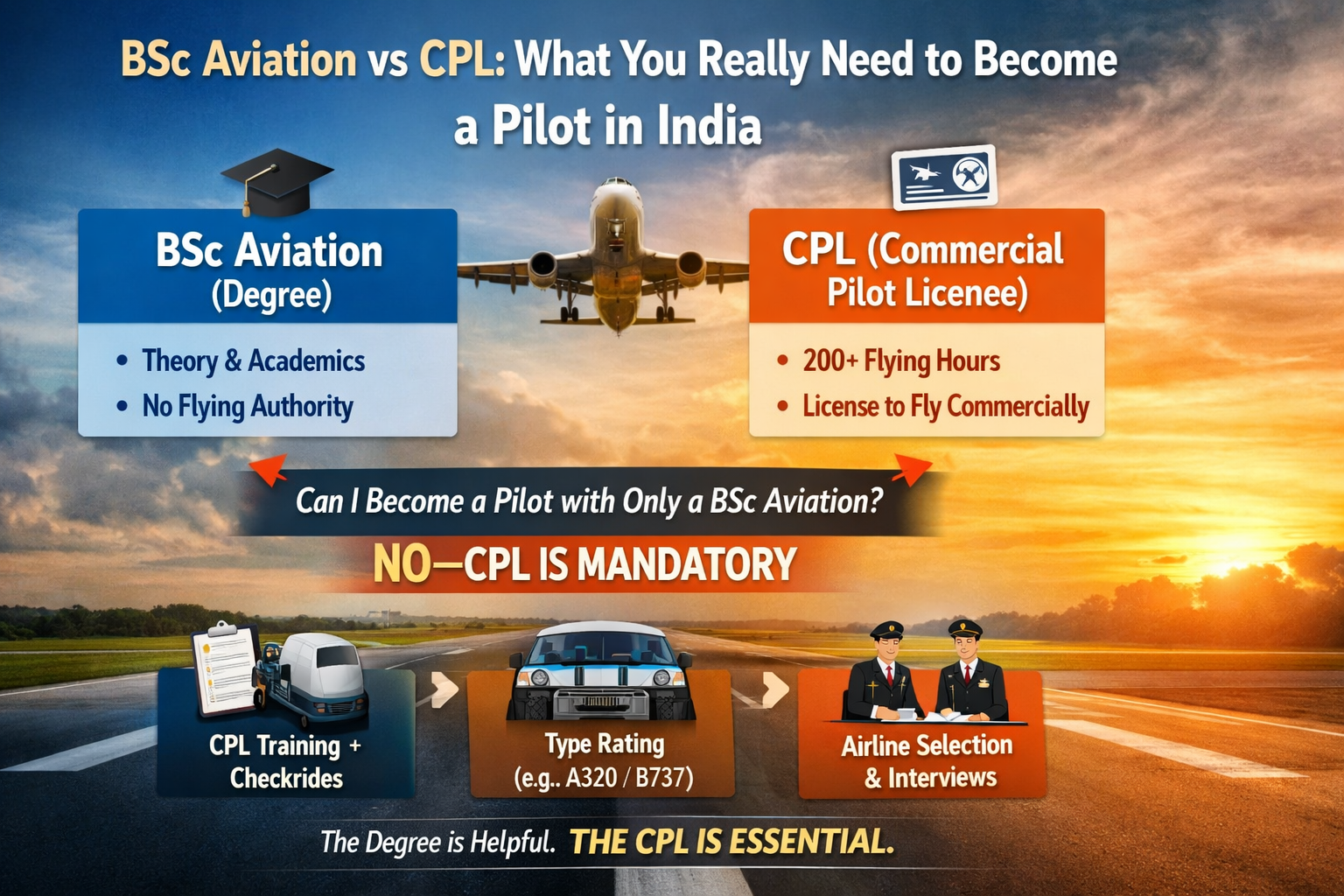
Choosing a career in aviation is exciting, but it also comes with a lot of confusion—especially around degrees like BSc Aviation and licences like CPL (Commercial Pilot Licence). Many students assume that completing a BSc Aviation is enough to become a pilot. The reality is a bit different, and understanding this early can save you time, money, and effort.
Let’s break it down clearly.
Understanding the Difference: Degree vs Licence
A BSc Aviation is an academic degree. It focuses on:
- Aviation theory (navigation, meteorology, air regulations)
- Airport and airline operations
- Basic technical knowledge of aircraft
On the other hand, a CPL (Commercial Pilot Licence) is a professional licence issued by the DGCA that allows you to:
- Fly aircraft commercially
- Work as a pilot and earn a salary
This is the key distinction:
A degree gives you knowledge. A CPL gives you the legal authority to fly.
Can You Become a Pilot with Only a BSc Aviation?
The simple answer is no.
Completing a BSc Aviation alone does not qualify you to become a pilot. Even if you have strong theoretical knowledge, airlines require:
- A valid CPL
- Required flying hours (minimum 200 hours in India)
- Medical certifications (DGCA Class 1 & 2)
Without a CPL, you cannot legally work as a pilot.
When Does BSc Aviation Make Sense?
Even though it’s not mandatory, a BSc Aviation can still be useful depending on your situation.
1. As a Strong Foundation
The subjects you study often overlap with DGCA exams, which can make your CPL journey smoother.
2. As a Backup Career
If for any reason you decide not to pursue flying, you still have opportunities in:
- Airport operations
- Airline management
- Ground handling
- Aviation safety roles
3. For Structured Learning
Some colleges integrate aviation training concepts with industry exposure, making it easier to transition into professional training later.
Different Paths to Becoming a Pilot
There is no single “correct” path. Here are the most common routes students take:
1. BSc Aviation → CPL
- Complete your degree first
- Then join a flying school for CPL training
This is a safer route for students who want a backup plan.
2. BSc Aviation + CPL Together
- Enroll in programs that align academics with flying training
Training ecosystems like MH Cockpit help students:
- Prepare for DGCA exams
- Plan their CPL timeline efficiently
- Get industry exposure early
This approach is more structured and reduces confusion.
3. Direct CPL (Skip Degree)
- Start flying training right after 12th
This is the fastest route if your only goal is to become a pilot, but it comes with higher financial commitment and no academic fallback.
Is a Pilot Job Guaranteed After CPL?
Another common misconception is that getting a CPL guarantees a job.
The reality:
- CPL is the minimum requirement
- Airlines hire based on demand, performance, and additional qualifications
After CPL, you still need:
- Type rating (specific aircraft training like Airbus A320 or Boeing 737)
- Airline selection process (interviews, simulator assessments)
Your training quality and preparation play a huge role here.
What Actually Matters More Than the Degree
Whether you choose BSc Aviation or not, your success as a pilot depends on:
- Quality of training
- Consistency and discipline
- DGCA exam performance
- Simulator skills and decision-making
- Right mentorship and guidance
This is where having the right training environment becomes important.
Why Guidance Matters in Aviation
Many students lose time because they:
- Choose the wrong sequence (degree vs CPL timing)
- Don’t understand DGCA requirements properly
- Lack clarity on the airline pathway
That’s why platforms like MH Cockpit are valuable. They don’t just focus on clearing exams—they help you:
- Understand the full pilot journey
- Plan your training step-by-step
- Avoid costly mistakes
Final Thoughts
If your goal is to become a pilot, here’s the truth:
- A BSc Aviation alone is not enough
- A CPL is mandatory
- The best path depends on your budget, timing, and career clarity
Think of it this way: The degree supports your journey—but the CPL defines your career.
Categories
Read More
"According to the latest report published by Data Bridge Market Research, the Biotechnology Tools Market Global biotechnology tools market size was valued at USD 76.84 billion in 2024 and is projected to reach USD 138.95 billion by 2032, with a CAGR of 7.70% during the forecast period of 2025 to 2032. Biotechnology Tools Market is the finest market research report which is the result...

In modern electronics, reliable and efficient connectivity is essential for optimal performance. This is where wire-to-board connectors come into play. These connectors provide the critical interface between wires and printed circuit boards (PCBs), ensuring a stable electrical connection across various devices. Used in industries such as automotive, telecommunications, and consumer electronics,...
Canada’s mobile landscape has evolved rapidly over the last decade. With high smartphone penetration, fast adoption of emerging technologies, and a digitally savvy population, Canadian mobile users now expect far more than just functional apps. Performance, personalization, security, accessibility, and seamless experiences have become the new standard. As a result, businesses must rethink...

The API Marketplace Market Size is experiencing rapid growth as organizations increasingly rely on APIs to accelerate digital transformation, enhance connectivity, and enable seamless data exchange across platforms. The market was valued at USD 21.36 billion in 2025 and is projected to reach USD 112.61 billion by 2035, growing at a robust CAGR of 18.13% during the forecast period...
Polaris Market Research has published a brand-new report titled Silver Wound Dressing Market Size, Share, & Industry Analysis Report: By Product (Traditional and Advanced), By Application, By Distribution Channel, By End Use, and By Region – Market Forecast, 2025–2034 that includes extensive information and analysis of the industry dynamics. The opportunities and...