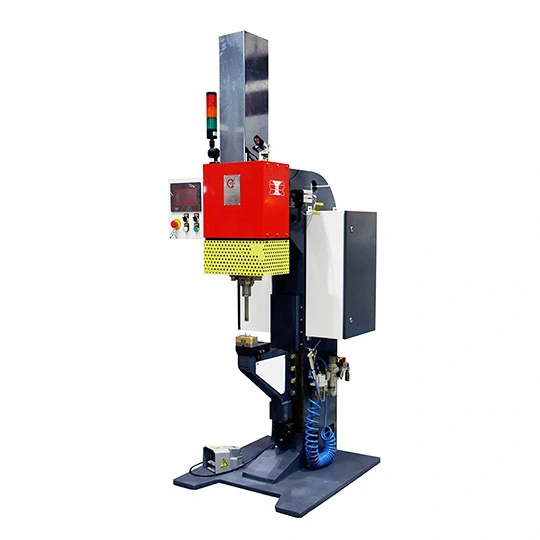
Self-pierce riveting (SPR) is a cold mechanical joining technology widely used in modern manufacturing to connect similar or dissimilar sheet materials without the need for pre-drilled holes. Unlike conventional fastening or welding methods, SPR creates a direct mechanical interlock by driving a specially designed rivet through the upper layers of materials while forming a secure flare within the bottom sheet without penetrating it completely.
This makes SPR especially valuable in industries where material integrity, lightweight design, and multi-material joining are critical, such as automotive body-in-white (BIW), aerospace assemblies, rail transport, and industrial equipment manufacturing.
For OEMs, automation integrators, and production engineers, SPR represents a scalable solution that supports high-speed automation while maintaining consistent joint quality.
What is Self-Pierce Riveting and How Does It Work?
The SPR process is based on controlled plastic deformation rather than heat fusion. A semi-tubular rivet is pressed into stacked sheets using a punch and die system:
Step-by-step process:
- Clamping: The sheets are firmly fixed between a punch and die.
- Piercing: The rivet penetrates the top layer(s) under high force.
- Flaring: Instead of passing through completely, the rivet expands inside the bottom sheet.
- Interlock formation: The material flows around the rivet tail, forming a strong mechanical lock.
The key engineering principle is the controlled deformation of both rivet and base material, which creates a permanent joint without melting or pre-drilling.
Key Advantages of Self-Pierce Riveting
SPR has become a preferred joining method in advanced manufacturing due to its strong performance in demanding environments.
1. No Pre-Drilling or Surface Preparation
SPR eliminates the need for hole punching or drilling, reducing cycle time and production complexity.
2. Strong Mechanical Interlock
The rivet flare creates a high-strength joint with excellent static and fatigue resistance, suitable for dynamic loading environments.
3. Multi-Material Capability
SPR can join:
- Aluminum to steel
- Aluminum to composites (CFRP)
- Multi-layer stacks with adhesives
This is critical for lightweight design strategies.
4. Cold Process (No Heat Affected Zone)
Because SPR does not rely on heat:
- No metallurgical weakening
- No distortion or thermal damage
- Better corrosion performance
5. High Automation Compatibility
SPR is highly suitable for robotic production lines, making it ideal for Industry 4.0 manufacturing systems.
Self-Pierce Riveting vs Other Joining Technologies
In industrial production, SPR is often compared with resistance spot welding, traditional riveting, and structural adhesives.
SPR vs Resistance Spot Welding
- SPR: No heat, no HAZ, better for mixed materials
- Spot welding: Faster for similar metals but limited for aluminum and dissimilar joints
SPR vs Mechanical Riveting
- SPR: No pre-hole required, faster cycle time
- Traditional riveting: Requires drilling and alignment
SPR vs Adhesive Bonding
- SPR: Immediate mechanical strength
- Adhesives: Need curing time and environmental control
In modern lightweight structures, SPR is often combined with adhesives for hybrid bonding, improving stiffness and durability.
Industrial Applications of Self-Pierce Riveting
SPR is widely used across industries where structural reliability and production efficiency are critical.
Automotive Industry
- Body-in-white structures
- Door panels, roofs, and chassis assemblies
- Electric vehicle lightweight structures
Aerospace & Aviation
- Lightweight fuselage components
- Interior panel assembly
- Multi-material structural joining
Rail & Transportation
- Train car body panels
- High-speed rail lightweight structures
Industrial Equipment Manufacturing
- Enclosures and frames
- HVAC and heavy machinery housings
- Energy and utility equipment assemblies
Process Parameters That Affect SPR Quality
For engineers and production specialists, controlling SPR quality is essential for repeatable manufacturing.
Key parameters include:
- Rivet geometry: diameter, hardness, and length
- Die design: cavity shape and depth
- Punch force: determines penetration and flaring behavior
- Sheet thickness combination: affects interlock formation
- Material ductility: influences crack resistance and flow behavior
Poor control of these parameters can lead to defects such as:
- Incomplete interlock
- Sheet cracking
- Rivet tilting
- Insufficient penetration
Common Defects and Quality Control in SPR
Like any precision joining process, SPR requires quality monitoring to ensure joint reliability.
Typical defects include:
- Empty riveting (no proper interlock)
- Sheet cracking at bottom layer
- Over-penetration or rivet breakout
- Misalignment in robotic application
Modern manufacturing addresses these issues using:
- Force-displacement monitoring systems
- Machine vision inspection
- AI-based defect detection
- Real-time process feedback control
These technologies are increasingly integrated into smart production lines.
Why Heron Welder for Self-Pierce Riveting Solutions?
As a global manufacturer of advanced joining technologies, Heron Welder specializes in industrial-grade solutions for modern manufacturing challenges.
Heron provides:
- Customized SPR systems for automotive and EV production lines
- Integration with robotic automation cells
- Multi-process platforms combining SPR, clinching, and resistance welding
- Precision engineering for high-volume production environments
- Process optimization support for OEMs and Tier suppliers
With decades of expertise in resistance welding and mechanical joining systems, Heron focuses on delivering reliable, scalable, and automation-ready solutions for complex manufacturing demands.
Future of Self-Pierce Riveting in Smart Manufacturing
The future of SPR is strongly aligned with Industry 4.0 trends:
- AI-driven process monitoring
- Digital twin simulation of rivet joints
- Fully automated multi-material assembly lines
- Increased adoption in EV and aerospace lightweight structures
- Hybrid joining systems combining SPR + adhesives + welding
As manufacturers continue to reduce weight while increasing structural strength, SPR will remain a key enabling technology.
Frequently Asked Questions (FAQs)
1. What materials can be joined using self-pierce riveting?
SPR is commonly used for aluminum, steel, and composite combinations, especially in multi-material assemblies.
2. Is self-pierce riveting stronger than welding?
In many applications, SPR provides superior fatigue resistance and is more suitable for dissimilar materials, though welding may still be faster for uniform metals.
3. Does SPR require pre-drilled holes?
No. SPR is a hole-free joining process that improves efficiency and reduces preparation time.
4. Can SPR be automated in production lines?
Yes. SPR is widely used in robotic and fully automated manufacturing systems.
5. What are the main industries using SPR?
Automotive, aerospace, rail transport, and industrial equipment manufacturing are the primary users.
Conclusion
Self-pierce riveting has become a cornerstone technology for modern manufacturing, enabling strong, lightweight, and multi-material structures without the limitations of welding or traditional fastening methods. Its compatibility with automation and high-performance production environments makes it essential for future-ready factories.
If you are looking to optimize your production line with advanced joining technology, Heron Welder can support your needs with customized SPR systems, automation integration, and engineering expertise.
Contact Heron today to request a consultation or customized quote and explore how self-pierce riveting solutions can enhance your manufacturing efficiency and product performance.