From Invisible to Essential: Top 10 Marketing Shifts in 2026
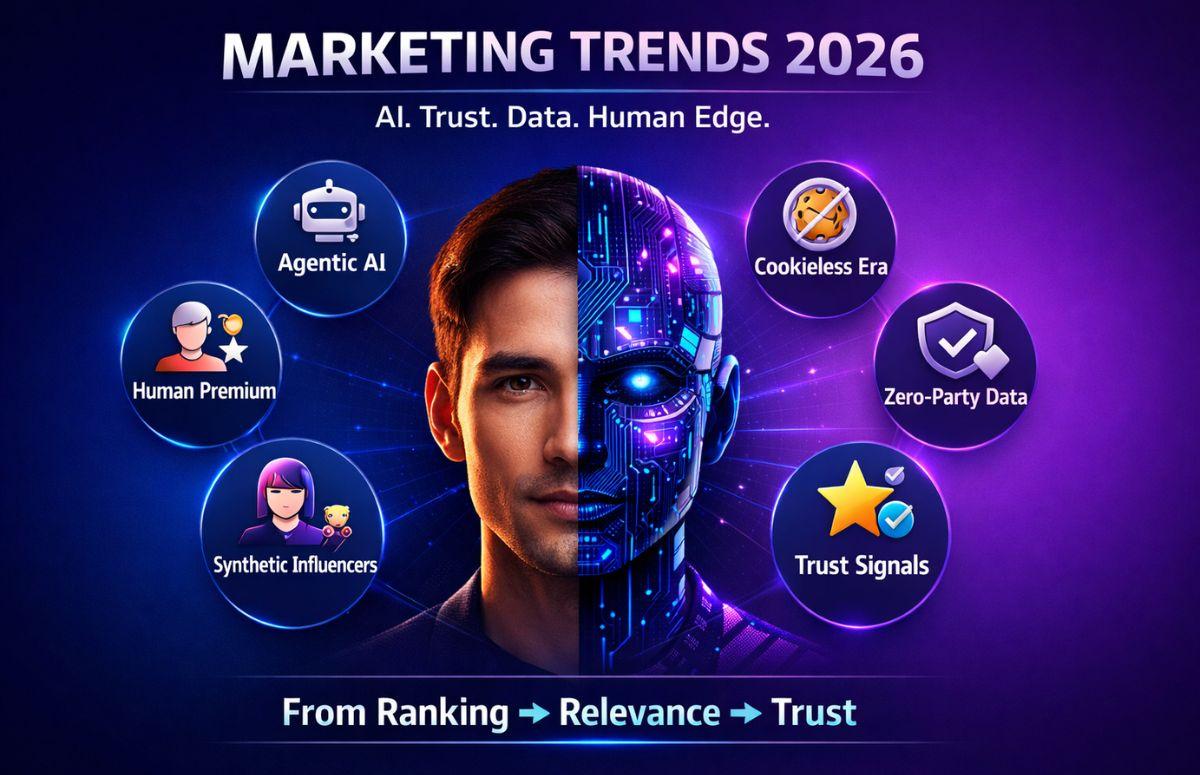
Somewhere right now a customer is buying from your competitor.
They did not find that competitor through a Google search. They did not click an ad. They did not see an influencer post. They opened an AI tool, described what they needed in plain conversational language, and received a confident recommendation. They acted on it in under two minutes. Your brand was not mentioned once.
That is not a worst-case scenario. That is Tuesday morning in 2026 playing out across millions of buying decisions every single day. The Top 10 Marketing Shifts in 2026 explain exactly why that is happening and what the brands capturing those decisions are doing differently from everyone else.
What Needs to End Before Anything Else Can Begin
Retargeting ads that follow people around the internet weeks after a single website visit are not conversion tools anymore. They are trust erosion engines. Audience targeting built on broad demographic brackets is not strategy. It is guesswork dressed in a spreadsheet. Influencer partnerships measured purely in follower counts and likes, with no credible line drawn to actual revenue, are expensive ways to feel productive without being productive.
These approaches are not losing effectiveness slowly. Their foundations have been removed. Accepting that honestly is the prerequisite for building something that actually works.
Shift One: AI Executes. Your Team Governs.
Agentic AI does not speed up marketing work. It performs the work entirely. Lead scoring, budget reallocation, creative testing, bid adjustments, churn detection, and personalized re-engagement sequences all happen continuously without anyone on your team initiating them.
Brands operating this way report eighty to ninety percent of routine decisions handled without human input and fifty percent reductions in operational overhead. The advantage does not belong to whoever adopted AI first. It belongs to whoever governs it most intelligently, with clear guardrails, first-party training data, and humans placed only at decisions that genuinely require human judgment.
Shift Two: Being Cited Matters More Than Ranking
Seventy-three percent of consumers use AI tools in their shopping journey. They ask a question, receive a synthesized answer, and act on it. No results page. No tab-switching. No clicking through to websites.
Answer Engine Optimization is about making your brand the answer AI cites. Generative Engine Optimization is about earning recognition from AI models as a credible authority in your category. Both require structured content, JSON-LD schema markup, machine-readable proof points, and FAQ content built around real buyer questions. That infrastructure is what AI engines evaluate when deciding whose brand gets recommended and whose gets ignored.
Shift Three: Your Data Has Holes You Are Not Accounting For
Third-party cookies are gone. Cross-site tracking is finished. If your measurement still depends on those mechanisms, your attribution numbers are lower than your actual performance and you are solving the wrong problem when results disappoint.
Server-side tagging recovers fifteen to thirty percent of lost conversion signals as a direct fix. A first-party identity graph built from loyalty behavior and direct customer interactions gives you targeting precision more reliable than anything the third-party ecosystem ever actually provided. Contextual advertising, long dismissed as a fallback, is now performing within five to eight percent of behavioral targeting on click-through rates while outperforming it on brand safety.
Shift Four: The Best Data Is the Data People Choose to Give You
Observed behavioral data tells you what someone did. Zero-party data tells you what they actually want because they chose to tell you directly.
When a customer completes your product quiz because the recommendation on the other side is genuinely useful, you learn something no algorithm could reliably infer. Brands combining zero-party data with AI personalization are seeing twenty-five percent improvements in attribution accuracy and customer lifetime value lifts exceeding twenty percent. The mechanism is simple. When someone tells you exactly what they need, your recommendations stop missing.
Shift Five: Synthetic Influencers Require Complete Honesty
AI-generated brand personas cost fifty to seventy percent less than traditional creator programs, operate without PR risk, and speak every language your market does. The sector is projected to exceed one hundred and seventy billion dollars by 2034.
The brands succeeding here are completely transparent about using them. Consumer backlash against undisclosed AI personas is severe and lasting. Use synthetic influencers for product demonstrations, tutorials, and multilingual content. Keep real humans at the center of storytelling and community building without exception.
Shift Six: People Do Not Abandon Carts Because of Friction. They Abandon Because of Uncertainty.
Customers do not buy the sofa when they cannot see it in their actual living room. They skip the foundation when they cannot confirm the shade on their own skin. No checkout optimization fixes that. Augmented reality does.
Virtual try-ons are already reducing return rates by up to thirty-six percent in live deployments. For beauty, apparel, eyewear, and home furnishing brands this is a current revenue decision, not a future roadmap consideration.
Shift Seven: Creator Partnerships Compound. Transactions Do Not.
Brands paying creators to post and moving on are generating exactly the ROI that arrangement deserves. The brands winning in creator marketing treat their most aligned creators as genuine partners, involving them in product decisions, giving them real economic upside, and building relationships that produce authentic advocacy rather than polished sponsored content.
Micro-community creators with ten thousand to a hundred and fifty thousand deeply engaged followers in a specific niche represent the highest ROI in this space. Nearly forty percent of consumers trust their recommendations as much as personal advice from friends.
Shift Eight: Human Creativity Is Rare Now and Rare Things Carry Premium Value
As AI fills every channel with technically competent content, consumers are actively seeking work made by real people. A measurable Human-Made premium is forming. AI belongs in work requiring speed and volume. Human creative teams belong in work requiring genuine cultural intuition, emotional intelligence, and the kind of unexpected thinking that makes someone stop scrolling because something actually surprised them.
Shift Nine: Algorithms Are Now Measuring Your Trustworthiness
Google, LinkedIn, and TikTok have built trust intensity signals directly into their distribution algorithms. Verified content generates thirty percent higher click-through rates than unverified content on platforms running trust scoring. In B2B, companies publishing verifiable employee satisfaction data and transparent sourcing information are closing enterprise deals twenty-five percent faster than competitors without those signals.
Verification is not just an ethical choice in 2026. It is a distribution advantage with measurable commercial outcomes.
Shift Ten: Redesign Your Team or Watch It Become Obsolete
AI is absorbing execution work across every marketing discipline. The roles gaining value are strategic and integrative. The marketer who designs AI workflows and writes the briefs directing them toward meaningful outcomes. The strategist translating creative vision into precise model-ready instruction. The educator building genuine AI fluency across an entire team.
Stop hiring for execution skills AI is making obsolete. Start building for strategic judgment and genuine operational fluency with the tools reshaping the function. Those people are rare. Find them before your competitors do.
The Thread Connecting All Ten
Every shift on this list moves in the same direction. Away from interruption and toward invitation. Away from extracting attention and toward earning trust. Away from guessing what consumers want and toward receiving that information through honest exchange.
The brands that own their categories by 2030 are building this infrastructure right now before it becomes obvious to everyone else.
The window is open. But the brands already moving through it are not waiting for company.
Catégories
Lire la suite
Skadar Lake, straddling the borders of Montenegro and Albania, is one of the Balkans’ most breathtaking natural wonders. Covering over 390 square kilometers, it is the largest lake in the region and a hotspot for travelers seeking scenic beauty, rich biodiversity, and cultural heritage. While the lake can be admired from the shore, the best way to experience its full charm is by...

In an era where digital experiences dominate our daily lives, platforms that blend technology, connectivity, and creativity have become the heart of modern entertainment. One such example is Govinda365 — a forward-thinking digital platform redefining how users engage, interact, and connect in the online entertainment ecosystem. From the evolution of online gaming to innovations...

Understanding the Academy Awards Nomination Procedures The Academy of Motion Pictures Arts and Sciences follows detailed protocols for nominating films across various categories. These procedures ensure fair representation and thorough evaluation of eligible works. Animation Category Nomination Process Introduced in 2001, the animated feature film category begins with the Short Films and...

Introduction Mahi brings a fiery fusion of flavor with the famous Espana Habanero Hot Sauce & Jolokia Hot Sauce Recipe, specially crafted for people who love bold taste and intense heat. Hot sauces are no longer just side condiments; they have become an essential part of modern kitchens and gourmet cooking. From tacos and burgers to grilled meats and snacks, a flavorful hot sauce can...
The process of installing smart security devices has reached its most user-friendly status. The guide presents a straightforward method for Ring Doorbell installation which enables you to protect your home through fast and effective implementation. The process of installing Ring Doorbell requires only basic technical knowledge because it does not need expert skills. The installation requires...