SPARK Matrix™: IT Service Management Tools – The Future of Intelligent IT Operations
Introduction
In today’s hyper-digital enterprise landscape, IT is no longer just a support function—it is the backbone of business innovation, resilience, and customer experience. Organizations are under constant pressure to deliver seamless IT services while managing increasing complexity. This is where IT Service Management Tools become indispensable.
QKS Group’s latest research on the IT Service Management Tools market provides a comprehensive view of how enterprises can transform IT operations into strategic value drivers. With evolving technologies such as AI, automation, and cloud, the ITSM landscape is undergoing a significant shift—one that demands smarter tools, faster responses, and deeper insights.
Click Here For More Information: https://qksgroup.com/market-research/spark-matrix-it-service-management-tools-q4-2025-9531
Market / Industry Overview
The IT Service Management Tools market has evolved from traditional ticketing systems into intelligent platforms that enable end-to-end service lifecycle management. These tools help organizations design, deliver, manage, and continuously improve IT services aligned with business objectives.
Modern ITSM platforms encompass:
- Incident and problem management
- Change and release management
- Asset and configuration management
- Service request fulfillment
- Knowledge management and analytics
According to QKS Group analysis, the market is witnessing rapid growth driven by digital transformation initiatives, hybrid work environments, and the increasing need for operational efficiency.
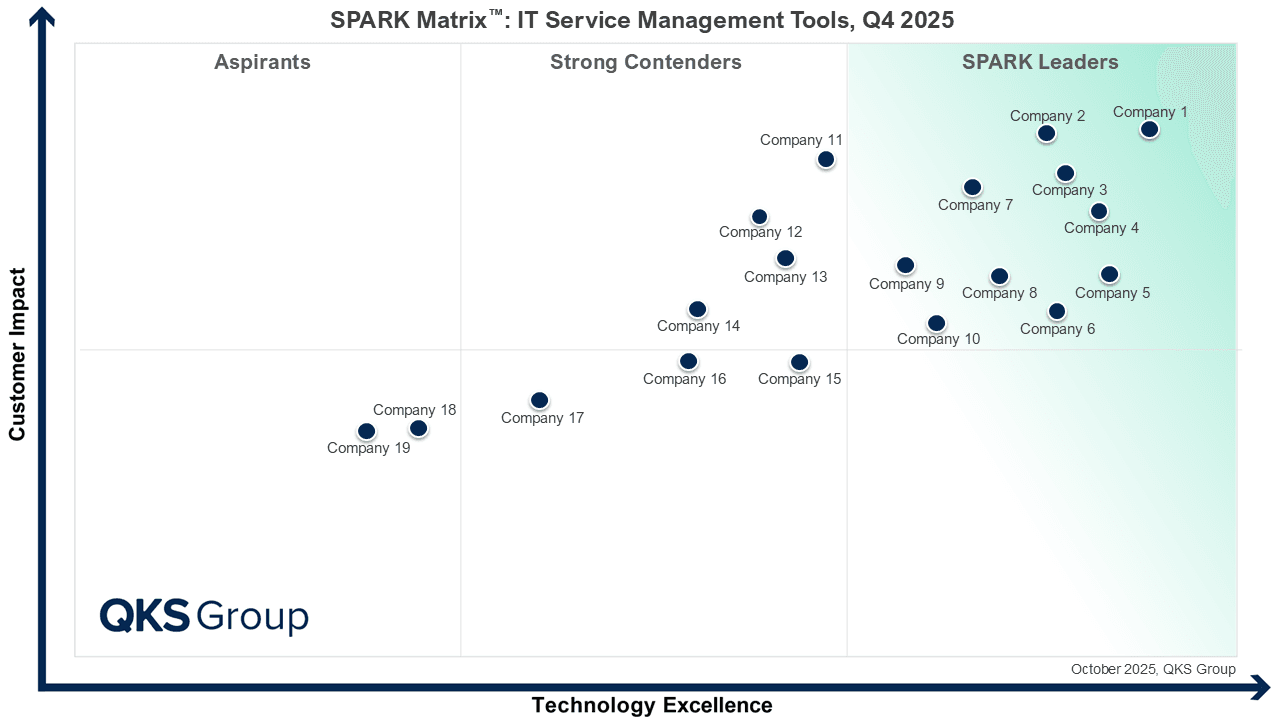
The SPARK Matrix™ provides a detailed competitive analysis of leading vendors such as Alemba, Aranda Software, Atlassian, BMC Software, EasyVista, Freshworks, Halo Service Solutions, IFS, Ivanti, Matrix42, OpenText, Pandora FMS, Proactivanet, Serviceaide, ServiceNow, SolarWinds, SymphonyAI, TOPdesk, and USU—ranking them based on technology excellence and customer impact.
Key Challenges Businesses Face
Despite the growing adoption of ITSM solutions, organizations face several critical challenges:
- Fragmented IT ecosystems: Multiple tools and silos lead to inefficiencies and lack of visibility.
- Manual processes: Legacy systems often rely heavily on manual intervention, slowing down service delivery.
- Rising user expectations: Employees and customers expect faster, seamless service experiences.
- Complex IT environments: Hybrid cloud, multi-vendor ecosystems, and distributed teams increase complexity.
- Limited analytics capabilities: Organizations struggle to derive actionable insights from IT data.
These challenges highlight the need for advanced ITSM platforms that are intelligent, integrated, and scalable.
Connect With Our Analyst: https://qksgroup.com/analyst-briefing?analystId=47&reportId=9531
Key Trends & Innovations
The IT Service Management Tools Market is being reshaped by several transformative trends:
1. AI-Powered ITSM
Artificial Intelligence is revolutionizing service management by enabling:
- Predictive incident management
- Automated root cause analysis
- Intelligent virtual agents and chatbots
AI-driven ITSM improves response times and enhances user experience significantly.
2. Hyperautomation
Automation is no longer optional. Organizations are leveraging:
- Workflow automation
- Robotic Process Automation (RPA)
- Self-healing systems
This reduces human intervention and improves operational efficiency.
3. Cloud-Native Platforms
Cloud-based ITSM solutions offer:
- Scalability and flexibility
- Faster deployment
- Lower total cost of ownership
SaaS-based ITSM platforms are becoming the preferred choice for enterprises.
4. Unified Service Management (USM)
ITSM is expanding beyond IT into enterprise service management (ESM), covering HR, finance, and customer support.
5. Advanced Analytics & Observability
Modern platforms integrate analytics to provide:
- Real-time dashboards
- Performance monitoring
- Data-driven decision-making
Benefits & Business Impact
Adopting advanced ITSM tools delivers measurable business value:
- Improved operational efficiency: Automation reduces manual workload and accelerates processes
- Enhanced user experience: Faster resolution times and self-service capabilities
- Cost optimization: Reduced downtime and optimized resource utilization
- Better compliance and governance: Standardized processes ensure regulatory adherence
- Scalability and agility: Organizations can adapt quickly to changing business needs
Ultimately, ITSM tools transform IT from a cost center into a strategic enabler of growth.
Use Cases or Real-World Examples
1. Global Enterprise IT Transformation
A multinational organization implemented an AI-driven ITSM platform to unify its global IT operations. The result:
- 40% reduction in incident resolution time
- Improved employee satisfaction
- Enhanced visibility across IT infrastructure
2. BFSI Sector Automation
A leading bank adopted automated change management workflows, reducing errors and ensuring compliance with regulatory standards.
3. Healthcare IT Optimization
Healthcare providers leveraged ITSM tools to ensure system uptime and manage critical applications, improving patient care delivery.
How Organizations Can Choose the Right Solution
Selecting the right ITSM solution requires a strategic approach:
1. Assess Business Needs
- Identify current pain points
- Define service management goals
2. Evaluate Key Capabilities
Look for:
- AI and automation features
- Integration capabilities
- User-friendly interface
3. Consider Scalability
Ensure the platform can grow with your organization.
4. Vendor Evaluation
Use frameworks like the SPARK Matrix™ to assess:
- Technology excellence
- Customer impact
- Market positioning
5. Total Cost of Ownership
Evaluate licensing, implementation, and maintenance costs.
Future Outlook (2025–2028)
The future of ITSM is intelligent, automated, and experience-driven. Between 2025 and 2028, the market is expected to witness:
- Widespread adoption of AI-first ITSM platforms
- Increased focus on employee experience (EX)
- Integration with DevOps and SecOps
- Expansion of ITSM into enterprise-wide service management
- Greater emphasis on predictive and autonomous IT operations
Organizations that invest in next-generation ITSM solutions will gain a competitive edge by improving agility, resilience, and innovation.
Download Sample Report Here: https://qksgroup.com/download-sample-form/spark-matrix-it-service-management-tools-q4-2025-9531
Conclusion
The evolution of IT Service Management Tools marks a pivotal shift in how organizations manage IT operations. From traditional service desks to intelligent, AI-driven platforms, ITSM is now a strategic pillar for digital transformation.
QKS Group’s SPARK Matrix™ provides critical insights into the competitive landscape, helping technology leaders make informed decisions. As businesses navigate increasing complexity and rising expectations, adopting the right ITSM solution is no longer optional—it is essential for sustained growth and operational excellence.
الأقسام
إقرأ المزيد
A successful painting project is the result of a clear, organized process that prioritizes communication, preparation, and quality. Prep Smart Painting has developed a proven four-step approach that ensures a seamless experience for homeowners and businesses in North Providence, RI, and the surrounding areas . From the initial consultation to the final walkthrough, their process is...

A beautiful smile is often associated with confidence, but healthy teeth are equally important for chewing, speaking, and maintaining overall oral health. When teeth are lost due to injury, decay, or gum disease, replacing them quickly can prevent future complications. Today, Dental implants in Islamabad offer a permanent solution that restores missing teeth while protecting the health of your...

Life doesn’t always go according to plan. Relationships evolve, circumstances change, and sometimes families need legal guidance to navigate the next chapter. When these situations arise, working with a family law lawyer in Minnetonka can help bring clarity to what might otherwise feel like a complicated process. Family law focuses on the legal issues that affect families things like...

Summer Games 2028 is gaining momentum as Dolph Lundgren takes on a major character in modern pentathlon. His relation to the sport goes back countless years. He has worked with athletes and sports groups before. His new role adds more value to the global image of the sport. His experience and public profile help bring more attention to this event before LA 28 begins. People across the globe...

You’ve invested time, money, and energy into creating the perfect Airbnb property in Coral Springs. You’ve styled it with comfortable furniture, stocked the kitchen with essentials, and maybe even added a charming patio set for guests to enjoy the Florida breeze. You get your first few bookings, and then the reviews start rolling in. Most are positive, but one stands out: “The...