


AI-Powered Transformation in Oil & Gas Industry: Market Set to Reach USD 10.1 Billion by 2034 Amid Rising Focus on Cost Efficiency, Safety, and Sustainability
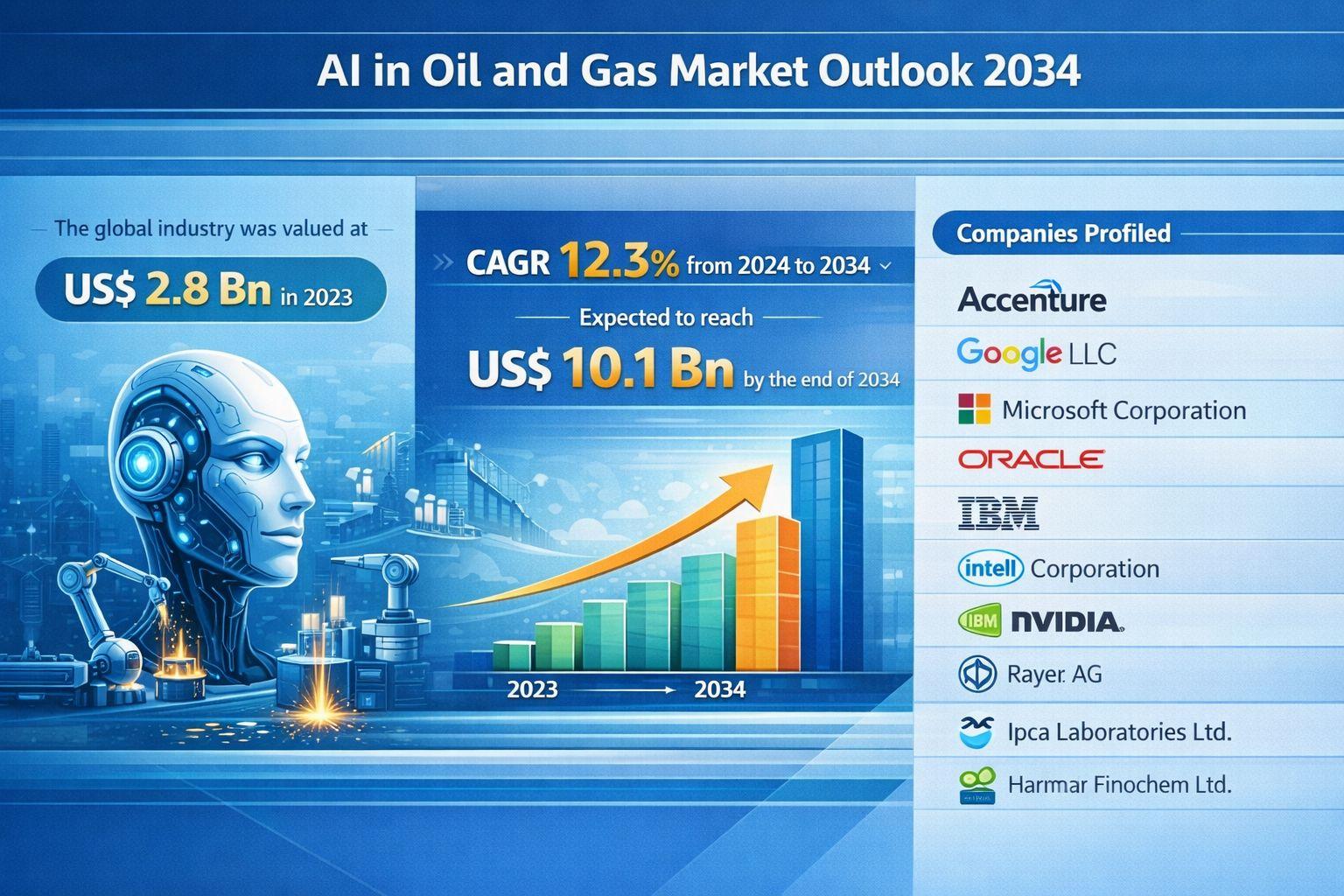
The global AI in oil and gas market is undergoing a transformative shift as digital technologies reshape traditional energy operations. Valued at US$ 2.8 Bn in 2023, the market is projected to expand at a robust CAGR of 12.3% from 2024 to 2034, reaching approximately US$ 10.1 Bn by 2034. This growth trajectory reflects the increasing adoption of artificial intelligence (AI) across upstream, midstream, and downstream activities, driven by the industry's need to enhance operational efficiency, reduce costs, and meet stringent environmental regulations.
Analyst Viewpoint: AI Driving Efficiency and Sustainability
A significant driver of market growth is the rising emphasis on cost management within oil & gas companies. In an industry characterized by fluctuating commodity prices and capital-intensive operations, AI offers a pathway to improved productivity and optimized resource allocation. By automating routine processes and enhancing data-driven decision-making, AI enables companies to achieve higher efficiency with fewer resources.
Additionally, the growing need to improve workplace safety and minimize environmental impact is accelerating AI adoption. Oil & gas operations inherently involve high-risk environments, and AI-powered systems can analyze real-time data to predict equipment failures, detect anomalies, and prevent accidents. This proactive approach not only safeguards personnel but also reduces operational downtime.
Another critical aspect is infrastructure monitoring. Leading companies are deploying AI-based solutions for mapping pipelines and facilities, identifying emission sources, and detecting leaks. These capabilities align with global efforts to reduce carbon footprints and improve environmental compliance.
Market Introduction: Expanding Role of AI in Oil & Gas
Artificial intelligence is rapidly gaining traction across industries, and the oil & gas sector is no exception. AI technologies are increasingly used to monitor and control wells, optimize drilling operations, and identify potential exploration sites with higher accuracy.
Predictive maintenance is one of the most impactful applications of AI in this sector. By analyzing equipment data, AI systems can forecast potential failures before they occur, reducing maintenance costs and preventing unexpected shutdowns. This capability significantly enhances operational efficiency and asset longevity.
AI also plays a crucial role in supply chain optimization. By analyzing variables such as transportation routes, weather patterns, and market demand, AI can streamline logistics and reduce inefficiencies. Furthermore, AI-driven demand forecasting helps companies manage inventory more effectively, particularly in volatile and nonlinear markets.
Machine learning models are being utilized to analyze vast datasets generated during exploration and production activities. These models can predict production outputs, optimize reservoir management, and improve decision-making processes. Cognitive computing further enhances oilfield operations by integrating diverse datasets, enabling better workflow coordination and operational insights.
Key Market Drivers
Rising Focus on Cost Management
Cost optimization remains a top priority for oil & gas companies. AI enables scalable operations, faster data processing, and improved quality control. By reducing reliance on manual labor and automating repetitive tasks, companies can significantly lower operational costs.
AI also accelerates research and development activities by enhancing data analysis and experimentation processes. This fosters innovation and enables companies to develop more efficient extraction and refining techniques.
Energy optimization is another critical benefit. AI systems can analyze energy consumption patterns and recommend adjustments to reduce waste. This not only lowers costs but also contributes to sustainability goals.
Global oil demand continues to rise, further supporting market growth. According to the Organization of the Petroleum Exporting Countries, demand is expected to increase by 38 million barrels per day to 115 mb/d by 2025, reflecting steady annual growth. This expansion in oil consumption necessitates advanced technologies like AI to manage increased production efficiently.
Increasing Focus on Safety and Environmental Impact
Safety remains a critical concern in oil & gas operations. AI-powered systems can monitor worksites in real time, identify potential hazards, and provide alerts for corrective actions. Technologies such as computer vision enhance surveillance capabilities, reducing the likelihood of accidents.
Environmental sustainability is another key driver. AI helps identify opportunities to reduce emissions and optimize operational processes. By predicting optimal conditions for refining and production, AI minimizes energy consumption and greenhouse gas emissions.
According to the International Energy Agency, oil & gas operations generated 5.1 billion tons of CO2-equivalent emissions in 2022. This has intensified the need for technologies that can mitigate environmental impact. AI solutions are increasingly being deployed to monitor emissions and recommend strategies for reduction.
Regional Outlook: North America Leading the Market
North America held the largest share of the AI in oil & gas market in 2023, driven by the region’s extensive oil production activities and technological advancements. The United States, one of the world’s leading petroleum producers, has a vast network of wells and infrastructure, creating significant opportunities for AI integration.
The region is also witnessing strong investment in research and development. A notable example is the collaboration between Google LLC and the Environmental Defense Fund to launch the MethaneSAT satellite in 2024. This initiative leverages AI and advanced analytics to detect and reduce methane emissions globally, highlighting the growing role of AI in environmental monitoring.
Competitive Landscape and Key Players
The AI in oil & gas market is highly competitive, with leading technology companies and solution providers investing heavily in innovation. Key players such as Accenture, Microsoft Corporation, Oracle, IBM, Intel Corporation, and NVIDIA Corporation are at the forefront of developing advanced AI solutions tailored for the energy sector.
These companies focus on enhancing operational predictability, improving asset performance, and helping oil & gas firms meet carbon emission targets. Their strategies include partnerships, product innovation, and expansion into emerging markets.
Key Developments Shaping the Market
Recent technological advancements underscore the growing importance of AI in the oil & gas sector. In March 2024, Saudi Aramco introduced its first generative AI model, Aramco Metabrain AI, featuring 250 billion parameters. This model is designed to generate insights and predictions, enabling more efficient operations.
Similarly, C3 AI launched its Generative AI Product Suite in 2023, including tools for enterprise search and data analysis. These solutions are applicable across multiple industries, including oil & gas, highlighting the cross-sector potential of AI technologies.
Market Segmentation Overview
The AI in oil & gas market is segmented based on function and operation. Key functional areas include production planning, maintenance, quality control, material movement, and reclamation. Among these, predictive maintenance and production optimization are expected to witness significant growth due to their direct impact on cost savings and efficiency.
By operation, the market is divided into upstream, midstream, and downstream segments. The upstream segment is anticipated to dominate, as AI plays a crucial role in exploration, drilling, and reservoir management.
Future Outlook: A Data-Driven Energy Ecosystem
The future of the oil & gas industry is increasingly data-driven, with AI at its core. As companies continue to digitize their operations, the integration of AI will become more widespread, enabling smarter decision-making and improved performance.
The growing emphasis on sustainability, coupled with regulatory pressures, will further accelerate AI adoption. Companies that invest in AI technologies will be better positioned to navigate market uncertainties, optimize operations, and achieve long-term growth.
In conclusion, the AI in oil & gas market is poised for significant expansion, driven by the dual imperatives of efficiency and sustainability. With advancements in machine learning, predictive analytics, and cognitive computing, AI is set to redefine the future of the energy sector, transforming it into a more resilient and environmentally responsible industry.
Categorias
Leia Mais
As per Market Research Futute, the Renewable Energy Market Share is witnessing an unprecedented rise, driven by the global shift towards clean energy, supportive government policies, and growing environmental awareness. The global energy landscape is undergoing a profound transformation as renewable sources like solar, wind, hydro, and bioenergy take center stage. With nations striving to...

In the ever-evolving world of streetwear, few collaborations have captured the attention of fashion enthusiasts and sneakerheads like the Corteiz x Nike Air Max 95. This partnership between the rebellious London-based streetwear brand Corteiz (CRTZ) and the legendary sportswear giant Nike represents more than just another sneaker drop — it symbolizes a new era of cultural crossover,...

"Agricultural Irrigation Automation Market Summary: According to the latest report published by Data Bridge Market Research, the Agricultural Irrigation Automation Market The global Agricultural Irrigation Automation Market was valued at USD 6.38 billion in 2025 and is projected to reach USD 20.36 billion by 2033, expanding at a CAGR of 15.60% during the forecast period.The universal...
According to the latest report published by Data Bridge Market Research, the Sodium Bicarbonate Crystals Market Data Bridge Market Research analyses that the sodium bicarbonate crystals market is expected to undergo a CAGR of 3.50% during the forecast period. This indicates that the market value, which was USD 14490.00 million in 2021, would rocket up to USD 19080.56 million by 2029...
"AI in Waste Management Market Summary: According to the latest report published by Data Bridge Market Research, the AI in Waste Management Market The global AI in waste management market size was valued at USD 42.51 billion in 2025 and is expected to reach USD 218.54 billion by 2033, at a CAGR of 22.71% during the forecast period Global AI in Waste...