


Thermal Fluids for Industrial Heaters Market Outlook 2034: Rising Demand for Food-Grade Heat Transfer Fluids and Oil & Gas Expansion to Drive Growth at 5.2% CAGR
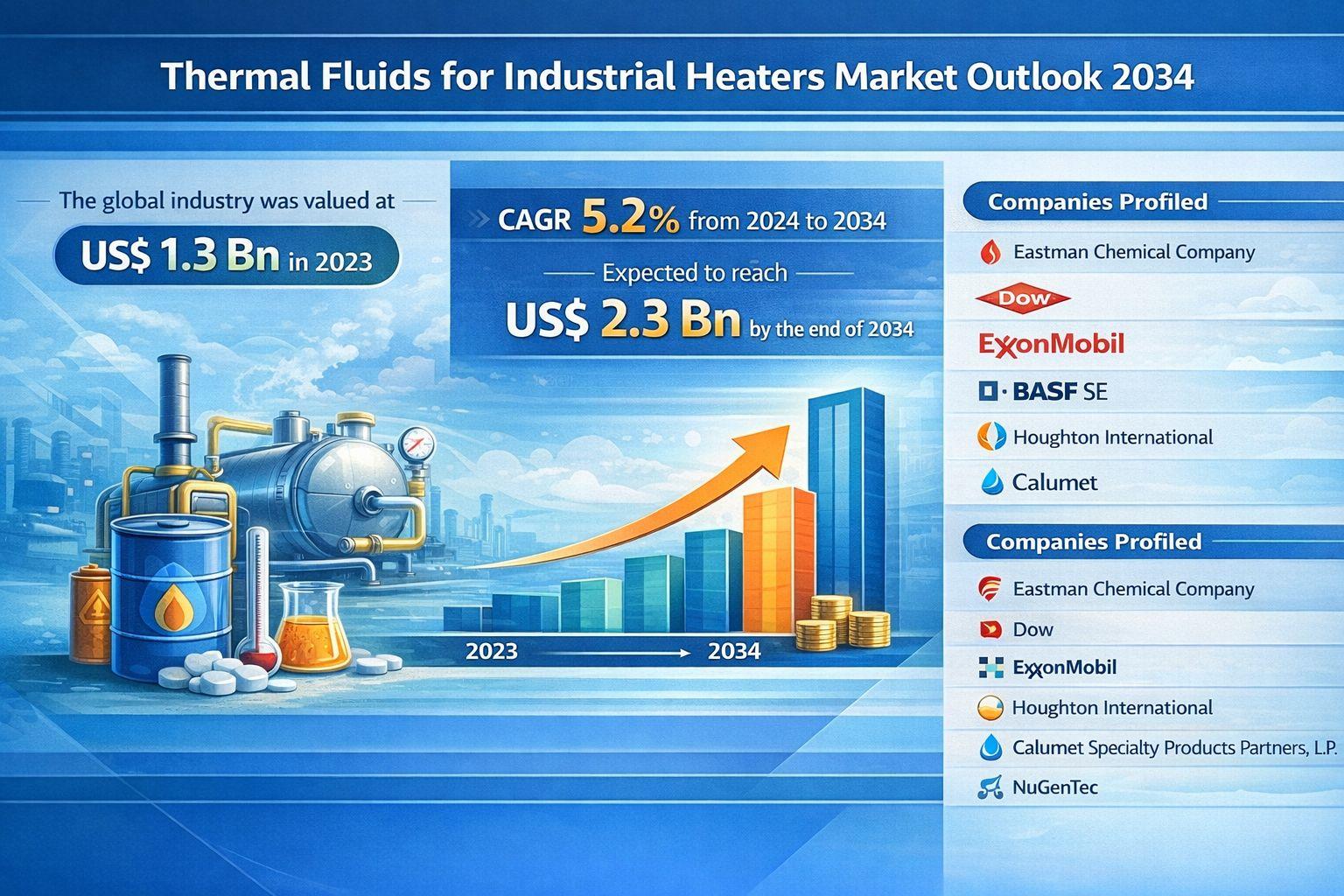
The global thermal fluids for industrial heaters market is witnessing steady expansion, driven by increasing industrialization, growing food processing activities, and rising energy demand across sectors. Valued at US$ 1.3 Bn in 2023, the market is projected to reach US$ 2.3 Bn by the end of 2034, advancing at a CAGR of 5.2% from 2024 to 2034. As industries continue to prioritize efficiency, safety, and sustainability, thermal fluids are becoming indispensable in modern heating systems.
Analyst Viewpoint
A key factor shaping market dynamics is the rising demand for food-grade heat transfer fluids. These fluids are increasingly preferred due to their safety, non-toxic properties, and suitability for indirect heating applications in sensitive environments such as food processing. Compared to conventional synthetic fluids, food-grade options offer improved compliance with safety standards and reduce contamination risks.
Simultaneously, expansion in the oil & gas sector is fueling demand for high-performance thermal fluids capable of operating under extreme temperatures for extended periods. Continuous investments in upstream and downstream operations are boosting the need for efficient heat transfer solutions.
Another promising avenue lies in the development of biodegradable thermal fluids. Ongoing R&D efforts are focusing on environmentally friendly formulations that can safely degrade without harming ecosystems. These innovations are particularly valuable in food additive manufacturing and environmentally regulated industries, offering lucrative opportunities for vendors.
Market Introduction
Thermal fluids, also known as heat transfer fluids, play a critical role in transmitting heat from a source to a process in industrial heating systems. These fluids ensure consistent and reliable thermal performance, making them essential across a wide range of industries.
The market includes several types of fluids such as mineral oils, synthetic fluids, glycols, molten salts, and emerging nanofluids. Among these, mineral oils remain the most widely used due to their cost-effectiveness and ability to operate efficiently at temperatures up to 290°C. Their chemical composition, typically consisting of paraffinic or naphthenic structures, provides stability and durability in moderate heating conditions.
However, synthetic fluids are gaining traction, particularly in demanding applications requiring higher thermal stability. These fluids are engineered to perform effectively at temperatures ranging from 150°C to 260°C and beyond, making them suitable for advanced industrial processes.
Additionally, water and water-glycol solutions are commonly used in systems requiring lower temperature ranges. Across industries such as chemical manufacturing, oil & gas, food & beverage, pharmaceuticals, and automotive, thermal fluids remain integral to process efficiency and product quality.
Key Market Drivers
Rise in Demand for Food-Grade Heat Transfer Fluids
The increasing adoption of food-grade heat transfer fluids is a significant growth driver. These fluids are widely used in food processing equipment such as fryers, ovens, kettles, and freezers. Operating within a temperature range of 36°C to 332°C, they provide safe and efficient heat transfer in indirect heating loops.
Growth in the food & beverage industry, fueled by rising consumption of processed and packaged foods, is directly contributing to this demand. Changing lifestyles, urbanization, and increased disposable income are encouraging consumers to opt for convenience foods, thereby boosting food processing activities globally.
For instance, studies have shown a notable rise in ultra-processed food consumption across major economies, further strengthening the need for reliable and safe thermal fluids. This trend is expected to continue, supporting long-term market expansion.
Expansion in Oil & Gas Sector
Thermal fluids are indispensable in oil & gas operations, including production, refining, transportation, and recycling processes. These fluids are specifically designed to withstand high temperatures and harsh operating conditions.
Synthetic thermal fluids, capable of functioning at temperatures up to 345°C, are particularly valuable in this sector. Their ability to maintain performance even in low-temperature environments enhances operational efficiency.
Global oil demand continues to rise, supported by economic growth and industrial expansion. Increased exploration and refining activities are translating into higher demand for advanced heat transfer solutions, thereby boosting the thermal fluids market.
Emerging Opportunities: Biodegradable and Nanofluid Innovations
Innovation is playing a crucial role in shaping the future of the market. Biodegradable thermal fluids are gaining attention as industries move toward sustainable practices. These fluids are designed to decompose into harmless substances, reducing environmental impact in case of leaks or disposal.
Moreover, advancements in nanotechnology are leading to the development of nanofluids with superior heat transfer capabilities. A notable example includes research conducted at the Indian Institute of Technology Guwahati, where scientists developed a nanofluid capable of efficiently transferring solar-generated heat for desalination systems. Such breakthroughs highlight the potential of next-generation thermal fluids.
Regional Outlook
Asia Pacific dominated the thermal fluids for industrial heaters market in 2023 and is expected to maintain its leadership position throughout the forecast period. Rapid industrialization, expanding food processing industries, and increasing energy demand are key factors driving growth in the region.
Countries like India and China are witnessing significant investments in food processing infrastructure. For example, India’s food processing sector is projected to achieve an output of US$ 535.0 Bn by 2025-26, creating substantial demand for food-grade heat transfer fluids across applications such as dairy, edible oils, fruits, vegetables, and beverages.
North America also represents a significant market, primarily driven by the robust oil & gas sector. The United States, being one of the largest producers of crude oil, continues to invest heavily in refining and processing activities, thereby boosting demand for thermal fluids.
Competitive Landscape and Key Players
The market is moderately consolidated, with leading players focusing on product innovation, strategic partnerships, and expansion of production capacities. Companies are developing high-performance synthetic fluids and environmentally sustainable solutions to meet evolving industry requirements.
Key players operating in the market include:
- Eastman Chemical Company
- Dow
- ExxonMobil
- BASF SE
- Houghton International
- Calumet Specialty Products Partners, L.P.
- NuGenTec
These companies are investing in advanced formulations tailored for high-temperature and industry-specific applications. Their strategies include expanding product portfolios, enhancing R&D capabilities, and strengthening global distribution networks.
Key Developments
Recent innovations highlight the dynamic nature of the market. In 2023, Dow introduced DOWFROST LC Heat Transfer Fluid, designed for direct-to-chip cooling applications. This product offers superior corrosion protection and efficient heat removal, catering to modern thermal management needs.
Additionally, breakthroughs in nanofluid technology are opening new avenues for renewable energy applications, particularly in solar thermal systems and desalination processes.
Market Segmentation Overview
The thermal fluids for industrial heaters market is segmented based on type and end-use industry.
By type, the market includes electric heaters, gas heaters, steam heaters, oil heaters, solar heaters, and others. Among these, oil and gas-based systems dominate due to their widespread industrial usage.
By end-use, major sectors include chemical, oil & gas, food & beverage, pharmaceutical, automotive, and others. The food & beverage and oil & gas segments are expected to remain key contributors to market growth.
Conclusion
The thermal fluids for industrial heaters market is set for steady growth through 2034, driven by increasing demand across critical industries and ongoing technological advancements. The shift toward food-grade and biodegradable fluids reflects a broader industry trend toward safety and sustainability.
With Asia Pacific leading the market and strong demand from oil & gas and food processing sectors, manufacturers have significant opportunities to innovate and expand. Companies that invest in advanced formulations, eco-friendly products, and high-performance solutions are likely to gain a competitive edge in this evolving landscape.
Категории
Больше
Limited Time Offer: ZoneAlarm Pro 2009 Available at No Cost for 24 Hours In celebration of Check Point Software's 15th anniversary, the company is giving away complimentary copies of their ZoneAlarm Pro 2009 firewall software. This special promotion begins Tuesday at 9:00 am EST and continues until Wednesday morning at the same time. The free download includes a full one-year license for a...

Keeping your vehicle clean is more than just appearance; it is about protecting your investment and maintaining long-term value. Many car owners overlook the importance of consistent detailing until wear and damage become visible. High-quality cleaning, polishing, and protection methods help preserve both the interior and exterior of a vehicle. In a busy urban environment, regular maintenance...

When users explore digital platforms, they often expect two things—ease of use and an engaging experience. Many platforms manage to offer one but struggle with the other. Introduction: Where Simplicity Meets Engagement When users explore digital platforms, they often expect two things—ease of use and an engaging experience. Many platforms manage to offer one but struggle...

El 2026 arranca con un público argentino que ya no se conforma con “lo de siempre”. Después de años de eventos híbridos y virtuales, la demanda real es volver al cara a cara, pero con experiencias que se sientan únicas e irrepetibles. La gran tendencia del año va a ser la hiperpersonalización emocional: bodas con storytelling...

Artificial Intelligence is no longer limited to research labs or large technology companies. Today, businesses across healthcare, finance, retail, manufacturing, and digital marketing rely on AI-powered solutions to improve efficiency and make data-driven decisions. This rapid adoption has created a strong demand for professionals who understand AI concepts and can apply them in...