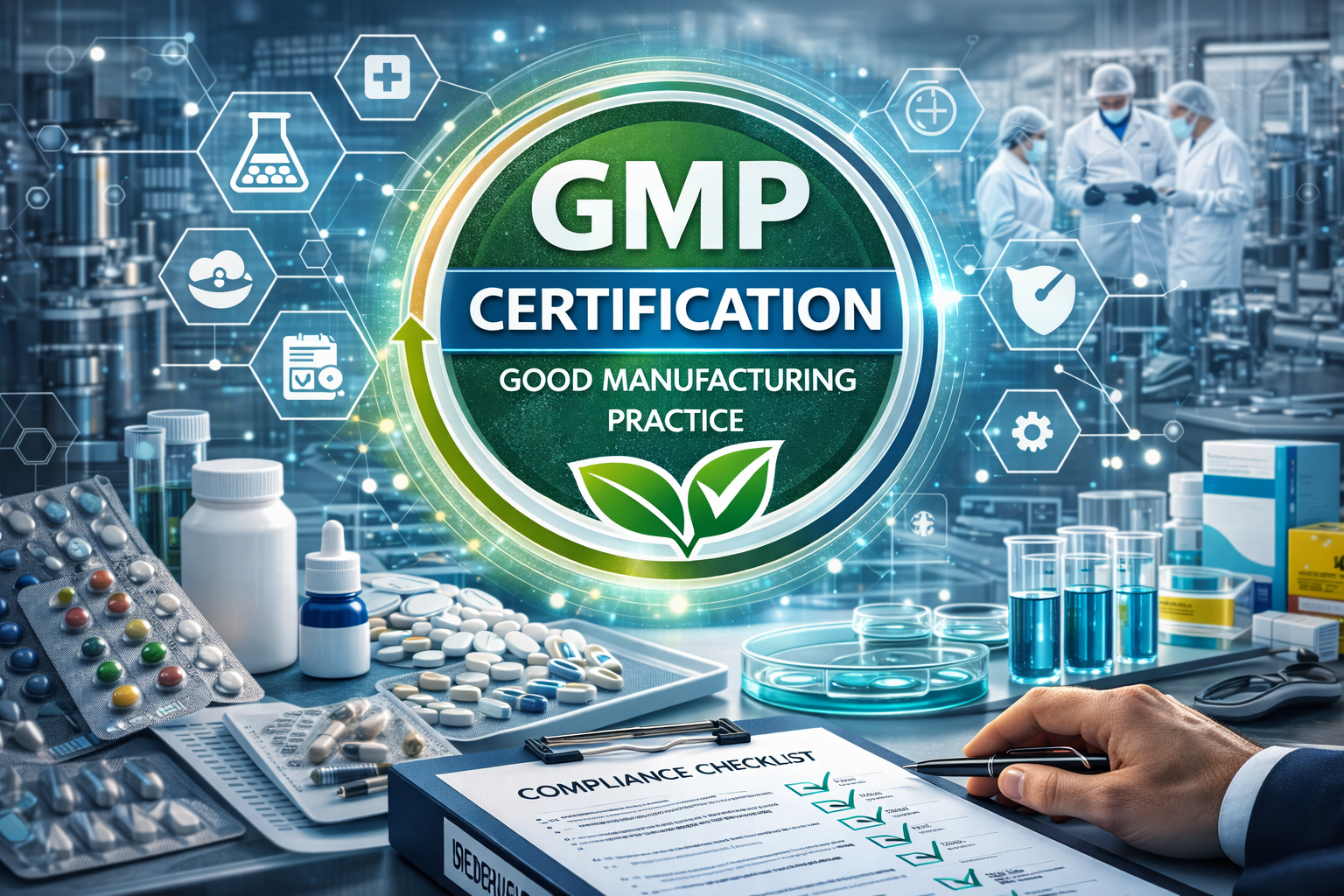
• Certification GMP: Ensuring Quality and Safety in Manufacturing
    Introduction to GMP Certification

    Certification GMP refers to compliance with Good Manufacturing Practices (GMP), a system designed to ensure that products are consistently produced and controlled according to established quality standards. GMP regulations are particularly critical in industries such as pharmaceuticals, food, cosmetics, and medical devices, where product safety directly impacts public health. Regulatory authorities such as the U.S. Food and Drug Administration and the European Medicines Agency enforce GMP requirements to ensure manufacturers meet strict quality and safety criteria. GMP certification demonstrates that a company’s production processes are reliable, traceable, and compliant with applicable regulations.

    Core Principles of Good Manufacturing Practices

    GMP is built on several key principles: quality management, proper documentation, validated processes, qualified personnel, controlled environments, and systematic monitoring. Manufacturers must establish clear procedures for every stage of production—from raw material sourcing to packaging and distribution. Facilities must be designed to prevent contamination, and equipment must be maintained and calibrated regularly. Employees must receive appropriate training to perform their tasks accurately and consistently. Detailed documentation is essential, ensuring that every batch can be traced and verified. These measures reduce the risk of defects, contamination, and product recalls.

    The GMP Certification Process

    Obtaining Certification GMP typically involves preparing the manufacturing facility to meet regulatory requirements and undergoing a formal inspection or audit. Companies first conduct a gap analysis to identify areas requiring improvement. Standard Operating Procedures (SOPs) are developed or updated, quality control systems are strengthened, and validation studies are performed to confirm that processes operate as intended. Regulatory inspectors or accredited certification bodies then conduct on-site evaluations to assess compliance. If the organization meets GMP standards, it receives certification or regulatory approval. Regular inspections are conducted to ensure ongoing adherence and continuous improvement.

    Integration with International Standards

    Many manufacturers integrate GMP requirements with internationally recognized management system standards to strengthen overall performance. For example, pharmaceutical and medical device companies often align GMP practices with ISO 13485, while food manufacturers may combine GMP principles with ISO 22000. These frameworks complement GMP by providing structured quality management systems, risk-based approaches, and documented processes. Although ISO certification and GMP compliance serve different regulatory purposes, integrating them enhances operational efficiency and audit readiness.

    Benefits of GMP Certification

    Certification GMP offers numerous strategic and operational advantages. It enhances product quality and safety, reduces the likelihood of regulatory penalties, and strengthens consumer confidence. In many industries, GMP compliance is mandatory for market access, making certification essential for both domestic and international trade. Companies that maintain strong GMP systems often experience fewer production errors, improved efficiency, and reduced waste. Certification also improves brand reputation by demonstrating a commitment to high manufacturing standards and regulatory compliance.

    Long-Term Commitment to Quality

    GMP certification is not a one-time achievement but a continuous responsibility. Manufacturers must maintain detailed records, conduct internal audits, monitor performance indicators, and respond promptly to deviations or non-conformities. Ongoing staff training and management oversight are essential to sustaining compliance. Ultimately, Certification GMP reflects a company’s dedication to delivering safe, high-quality products while meeting regulatory expectations. By embedding quality into every stage of production, organizations build trust, ensure consumer safety, and support long-term business sustainability.

    Web: https://iasiso-europe.com/french/cgmp-certification-en-france/
    Certification GMP: Ensuring Quality and Safety in Manufacturing Introduction to GMP Certification Certification GMP refers to compliance with Good Manufacturing Practices (GMP), a system designed to ensure that products are consistently produced and controlled according to established quality standards. GMP regulations are particularly critical in industries such as pharmaceuticals, food, cosmetics, and medical devices, where product safety directly impacts public health. Regulatory authorities such as the U.S. Food and Drug Administration and the European Medicines Agency enforce GMP requirements to ensure manufacturers meet strict quality and safety criteria. GMP certification demonstrates that a company’s production processes are reliable, traceable, and compliant with applicable regulations. Core Principles of Good Manufacturing Practices GMP is built on several key principles: quality management, proper documentation, validated processes, qualified personnel, controlled environments, and systematic monitoring. Manufacturers must establish clear procedures for every stage of production—from raw material sourcing to packaging and distribution. Facilities must be designed to prevent contamination, and equipment must be maintained and calibrated regularly. Employees must receive appropriate training to perform their tasks accurately and consistently. Detailed documentation is essential, ensuring that every batch can be traced and verified. These measures reduce the risk of defects, contamination, and product recalls. The GMP Certification Process Obtaining Certification GMP typically involves preparing the manufacturing facility to meet regulatory requirements and undergoing a formal inspection or audit. Companies first conduct a gap analysis to identify areas requiring improvement. Standard Operating Procedures (SOPs) are developed or updated, quality control systems are strengthened, and validation studies are performed to confirm that processes operate as intended. Regulatory inspectors or accredited certification bodies then conduct on-site evaluations to assess compliance. If the organization meets GMP standards, it receives certification or regulatory approval. Regular inspections are conducted to ensure ongoing adherence and continuous improvement. Integration with International Standards Many manufacturers integrate GMP requirements with internationally recognized management system standards to strengthen overall performance. For example, pharmaceutical and medical device companies often align GMP practices with ISO 13485, while food manufacturers may combine GMP principles with ISO 22000. These frameworks complement GMP by providing structured quality management systems, risk-based approaches, and documented processes. Although ISO certification and GMP compliance serve different regulatory purposes, integrating them enhances operational efficiency and audit readiness. Benefits of GMP Certification Certification GMP offers numerous strategic and operational advantages. It enhances product quality and safety, reduces the likelihood of regulatory penalties, and strengthens consumer confidence. In many industries, GMP compliance is mandatory for market access, making certification essential for both domestic and international trade. Companies that maintain strong GMP systems often experience fewer production errors, improved efficiency, and reduced waste. Certification also improves brand reputation by demonstrating a commitment to high manufacturing standards and regulatory compliance. Long-Term Commitment to Quality GMP certification is not a one-time achievement but a continuous responsibility. Manufacturers must maintain detailed records, conduct internal audits, monitor performance indicators, and respond promptly to deviations or non-conformities. Ongoing staff training and management oversight are essential to sustaining compliance. Ultimately, Certification GMP reflects a company’s dedication to delivering safe, high-quality products while meeting regulatory expectations. By embedding quality into every stage of production, organizations build trust, ensure consumer safety, and support long-term business sustainability. Web: https://iasiso-europe.com/french/cgmp-certification-en-france/
    Certification GMP | Bonnes Pratiques de Fabrication - IAS
    iasiso-europe.com
    La certification GMP valide qu'une organisation a mis en place de bonnes pratiques de fabrication pour assurer la sécurité et la qualité des produits.
    0 Reacties ·0 aandelen ·655 Views ·0 voorbeeld
  • FDA Certificaat: Gaining Compliance and Access to the U.S. Market

    What Is an FDA Certificaat and Why It Matters

    An FDA certificaat is often understood as proof that a product or facility complies with the regulations of the U.S. Food and Drug Administration (FDA). While the FDA itself does not “certify” products in the traditional sense, registration, approval, or compliance with FDA rules is essential for legally marketing certain products in the United States. This includes food, beverages, dietary supplements, cosmetics, pharmaceuticals, and medical devices. Obtaining an FDA certificaat signals that a company meets the high standards expected in one of the world’s most regulated and lucrative markets.

    Products Covered by FDA Regulations

    The FDA oversees a wide variety of products to protect public health. Food and beverages, including dietary supplements, must follow safety, labeling, and manufacturing rules. Cosmetics must meet labeling requirements and avoid harmful ingredients. Medical devices, from simple instruments to complex diagnostic equipment, require compliance with quality system regulations. Pharmaceuticals must meet rigorous approval processes. Even some electronics and veterinary products fall under FDA oversight. Understanding which regulations apply is the first step in obtaining an FDA certificaat.

    Who Needs an FDA Certificaat?

    Any company that manufactures, processes, packs, distributes, or imports FDA-regulated products for the U.S. market is required to comply with FDA regulations. This applies to both U.S.-based and international manufacturers exporting to the United States. Distributors, importers, and private label companies also have responsibilities under FDA law. As such, an FDA certificaat is not just a formality; it is a critical requirement for market access and international trade.

    Benefits of Obtaining an FDA Certificaat

    An FDA certificaat offers significant business advantages. Firstly, it allows companies to legally enter the U.S. market, opening access to millions of consumers. Secondly, it builds credibility with partners, distributors, and customers, signaling that the organization adheres to strict safety and quality standards. Additionally, compliance with FDA rules often leads to improved internal processes, higher product quality, and reduced risk of recalls or legal issues. For international companies, an FDA certificaat is a mark of global trust and competitiveness.

    The Process to Obtain an FDA Certificaat

    Obtaining an FDA certificaat begins with identifying the correct regulatory pathway for the product. Companies must register their facilities with the FDA, list their products, and ensure that labeling, packaging, and manufacturing meet the FDA’s requirements. Certain products, like medical devices or pharmaceuticals, may require premarket notifications or approvals. The FDA also conducts inspections or audits to verify compliance. Once requirements are satisfied, the organization can legally market its products in the United States, effectively obtaining an FDA certificaat.

    Challenges in FDA Compliance

    Navigating FDA regulations can be complex. Differences in regulatory requirements for food, cosmetics, medical devices, and pharmaceuticals mean that companies must carefully analyze which rules apply. Language barriers, unfamiliar documentation procedures, and evolving regulatory updates can further complicate compliance. Many organizations work with consultants or regulatory experts to streamline the process and avoid costly delays.

    FDA Certification as a Strategic Business Tool

    Obtaining an FDA certificaat is not just about compliance—it is a strategic investment. Beyond legal access, it demonstrates a company’s commitment to safety, quality, and transparency. Companies with FDA-compliant products often gain a competitive advantage in both domestic and international markets. In industries where consumer trust and regulatory approval are critical, an FDA certificaat can be the difference between market entry and missed opportunities.

    Web: https://iasiso-europe.com/dutch/fda-certificering-in-nederland/
    FDA Certificaat: Gaining Compliance and Access to the U.S. Market What Is an FDA Certificaat and Why It Matters An FDA certificaat is often understood as proof that a product or facility complies with the regulations of the U.S. Food and Drug Administration (FDA). While the FDA itself does not “certify” products in the traditional sense, registration, approval, or compliance with FDA rules is essential for legally marketing certain products in the United States. This includes food, beverages, dietary supplements, cosmetics, pharmaceuticals, and medical devices. Obtaining an FDA certificaat signals that a company meets the high standards expected in one of the world’s most regulated and lucrative markets. Products Covered by FDA Regulations The FDA oversees a wide variety of products to protect public health. Food and beverages, including dietary supplements, must follow safety, labeling, and manufacturing rules. Cosmetics must meet labeling requirements and avoid harmful ingredients. Medical devices, from simple instruments to complex diagnostic equipment, require compliance with quality system regulations. Pharmaceuticals must meet rigorous approval processes. Even some electronics and veterinary products fall under FDA oversight. Understanding which regulations apply is the first step in obtaining an FDA certificaat. Who Needs an FDA Certificaat? Any company that manufactures, processes, packs, distributes, or imports FDA-regulated products for the U.S. market is required to comply with FDA regulations. This applies to both U.S.-based and international manufacturers exporting to the United States. Distributors, importers, and private label companies also have responsibilities under FDA law. As such, an FDA certificaat is not just a formality; it is a critical requirement for market access and international trade. Benefits of Obtaining an FDA Certificaat An FDA certificaat offers significant business advantages. Firstly, it allows companies to legally enter the U.S. market, opening access to millions of consumers. Secondly, it builds credibility with partners, distributors, and customers, signaling that the organization adheres to strict safety and quality standards. Additionally, compliance with FDA rules often leads to improved internal processes, higher product quality, and reduced risk of recalls or legal issues. For international companies, an FDA certificaat is a mark of global trust and competitiveness. The Process to Obtain an FDA Certificaat Obtaining an FDA certificaat begins with identifying the correct regulatory pathway for the product. Companies must register their facilities with the FDA, list their products, and ensure that labeling, packaging, and manufacturing meet the FDA’s requirements. Certain products, like medical devices or pharmaceuticals, may require premarket notifications or approvals. The FDA also conducts inspections or audits to verify compliance. Once requirements are satisfied, the organization can legally market its products in the United States, effectively obtaining an FDA certificaat. Challenges in FDA Compliance Navigating FDA regulations can be complex. Differences in regulatory requirements for food, cosmetics, medical devices, and pharmaceuticals mean that companies must carefully analyze which rules apply. Language barriers, unfamiliar documentation procedures, and evolving regulatory updates can further complicate compliance. Many organizations work with consultants or regulatory experts to streamline the process and avoid costly delays. FDA Certification as a Strategic Business Tool Obtaining an FDA certificaat is not just about compliance—it is a strategic investment. Beyond legal access, it demonstrates a company’s commitment to safety, quality, and transparency. Companies with FDA-compliant products often gain a competitive advantage in both domestic and international markets. In industries where consumer trust and regulatory approval are critical, an FDA certificaat can be the difference between market entry and missed opportunities. Web: https://iasiso-europe.com/dutch/fda-certificering-in-nederland/
    FDA certificaat | Voedsel Export Certificaat - IAS Nederland
    iasiso-europe.com
    Verkrijg een FDA certificaat van IAS om in aanmerking te komen om uw producten in de VS te verkopen! Vraag nu een gratis adviesgesprek aan bij IAS!
    0 Reacties ·0 aandelen ·1K Views ·0 voorbeeld
  • GMP Certificering: Ensuring Quality and Compliance in Manufacturing

    Introduction to GMP Certificering

    GMP certificering, or Good Manufacturing Practice certification, is a globally recognized system that ensures products are consistently produced and controlled according to established quality standards. GMP certificering is essential for industries where product quality and safety are critical, such as pharmaceuticals, food and beverages, cosmetics, medical devices, and dietary supplements. By implementing GMP requirements, organizations can minimize risks related to contamination, errors, and inconsistencies, ensuring that products meet regulatory and customer expectations.

    Purpose and Scope of GMP Certificering

    The main purpose of GMP certificering is to create a controlled manufacturing environment that guarantees product safety and quality. GMP focuses on preventive measures rather than relying solely on final product testing. GMP certificering applies to all stages of production, including raw material handling, processing, packaging, storage, and distribution. It provides a structured framework that helps organizations comply with national and international regulations while maintaining consistent manufacturing practices.

    Key Requirements of GMP Certificering

    GMP certificering is based on several core requirements that cover every aspect of the manufacturing process. These include appropriate facility design, equipment validation, and maintenance to prevent contamination and mix-ups. GMP certificering also emphasizes qualified and trained personnel, strict hygiene practices, and clear organizational responsibilities. Documentation is a critical element, requiring standard operating procedures (SOPs), batch records, and quality manuals. Effective quality control, traceability, complaint handling, and recall procedures are also mandatory under GMP certificering.

    Benefits of GMP Certificering

    GMP certificering offers significant advantages for organizations operating in regulated markets. By following GMP principles, companies can reduce product defects, rework, and waste, leading to improved efficiency and lower operational costs. GMP certificering enhances customer confidence and strengthens brand reputation by demonstrating a commitment to quality and safety. It also supports compliance with regulatory inspections and audits, reducing the risk of penalties, product recalls, and business disruptions. Furthermore, GMP certificering helps organizations gain access to international markets and partnerships.

    Who Needs GMP Certificering

    GMP certificering is essential for manufacturers in industries such as pharmaceuticals, biotechnology, food processing, cosmetics, and healthcare products. It is suitable for both small and large organizations, as GMP requirements can be scaled according to the size and complexity of operations. GMP certificering is often a mandatory requirement for companies seeking to export products or supply regulated markets.

    Conclusion

    GMP certificering is a fundamental standard for ensuring product quality, safety, and regulatory compliance. By achieving GMP certificering, organizations establish reliable manufacturing processes, protect consumer health, and demonstrate continuous commitment to quality improvement. GMP certificering not only supports compliance but also provides a strong foundation for sustainable growth and long-term success in competitive global industries.

    Web: https://iasiso-europe.com/dutch/cgmp-certificering-in-nederland/
    GMP Certificering: Ensuring Quality and Compliance in Manufacturing Introduction to GMP Certificering GMP certificering, or Good Manufacturing Practice certification, is a globally recognized system that ensures products are consistently produced and controlled according to established quality standards. GMP certificering is essential for industries where product quality and safety are critical, such as pharmaceuticals, food and beverages, cosmetics, medical devices, and dietary supplements. By implementing GMP requirements, organizations can minimize risks related to contamination, errors, and inconsistencies, ensuring that products meet regulatory and customer expectations. Purpose and Scope of GMP Certificering The main purpose of GMP certificering is to create a controlled manufacturing environment that guarantees product safety and quality. GMP focuses on preventive measures rather than relying solely on final product testing. GMP certificering applies to all stages of production, including raw material handling, processing, packaging, storage, and distribution. It provides a structured framework that helps organizations comply with national and international regulations while maintaining consistent manufacturing practices. Key Requirements of GMP Certificering GMP certificering is based on several core requirements that cover every aspect of the manufacturing process. These include appropriate facility design, equipment validation, and maintenance to prevent contamination and mix-ups. GMP certificering also emphasizes qualified and trained personnel, strict hygiene practices, and clear organizational responsibilities. Documentation is a critical element, requiring standard operating procedures (SOPs), batch records, and quality manuals. Effective quality control, traceability, complaint handling, and recall procedures are also mandatory under GMP certificering. Benefits of GMP Certificering GMP certificering offers significant advantages for organizations operating in regulated markets. By following GMP principles, companies can reduce product defects, rework, and waste, leading to improved efficiency and lower operational costs. GMP certificering enhances customer confidence and strengthens brand reputation by demonstrating a commitment to quality and safety. It also supports compliance with regulatory inspections and audits, reducing the risk of penalties, product recalls, and business disruptions. Furthermore, GMP certificering helps organizations gain access to international markets and partnerships. Who Needs GMP Certificering GMP certificering is essential for manufacturers in industries such as pharmaceuticals, biotechnology, food processing, cosmetics, and healthcare products. It is suitable for both small and large organizations, as GMP requirements can be scaled according to the size and complexity of operations. GMP certificering is often a mandatory requirement for companies seeking to export products or supply regulated markets. Conclusion GMP certificering is a fundamental standard for ensuring product quality, safety, and regulatory compliance. By achieving GMP certificering, organizations establish reliable manufacturing processes, protect consumer health, and demonstrate continuous commitment to quality improvement. GMP certificering not only supports compliance but also provides a strong foundation for sustainable growth and long-term success in competitive global industries. Web: https://iasiso-europe.com/dutch/cgmp-certificering-in-nederland/
    GMP certificaat | GMP certificering - IAS Nederland
    iasiso-europe.com
    GMP certificaat behalen bij IAS in Nederland om ervoor te zorgen dat u kwaliteitsproducten en -diensten aan klanten levert! Nu toepassen!
    0 Reacties ·0 aandelen ·2K Views ·0 voorbeeld
  • Frankincense Carterii Essential Oil

    Boswellia carterii, also known as Indian frankincense, is a tree native to India and the Middle East. Its resin has been used for centuries in traditional medicine, Ayurveda, and cosmetics. The essential oil extracted from its resin, commonly known as Frankincense oil, has gained popularity in recent years due to its potential benefits for skin and hair care. Its essential oil has also been used for centuries in traditional medicine, perfumery, and cosmetics due to its unique properties and benefits. Read more: https://aromaticscanada.ca/shop/oils/essential-oils/essential-oils-ag/frankincense-carterii-essential-oil

    #frankincensecarteriiessentialoil #essentialoil
    Frankincense Carterii Essential Oil Boswellia carterii, also known as Indian frankincense, is a tree native to India and the Middle East. Its resin has been used for centuries in traditional medicine, Ayurveda, and cosmetics. The essential oil extracted from its resin, commonly known as Frankincense oil, has gained popularity in recent years due to its potential benefits for skin and hair care. Its essential oil has also been used for centuries in traditional medicine, perfumery, and cosmetics due to its unique properties and benefits. Read more: https://aromaticscanada.ca/shop/oils/essential-oils/essential-oils-ag/frankincense-carterii-essential-oil #frankincensecarteriiessentialoil #essentialoil
    Frankincense Carterii Essential Oil – Pure & Natural
    aromaticscanada.ca
    Shop Frankincense Carterii Essential Oil for wellness and aromatherapy. Premium quality and pure oil. Buy now for fast, reliable delivery.
    0 Reacties ·0 aandelen ·971 Views ·0 voorbeeld
  • Fatty Acid Prices, Trends, News, Index, Chart, Demand and Forecast
    The global fatty acid market has witnessed significant fluctuations over the recent quarter, influenced by feedstock cost variations, seasonal demand shifts, and downstream sector consumption patterns. This article provides a comprehensive analysis of fatty acid prices in key regions, including North America, Asia-Pacific (APAC), and Europe, highlighting the underlying factors driving market movements and forecasting near-term trends.

    North America Fatty Acid Price Trends

    USA: Decline in Fatty Acid Price Index

    In the United States, the Fatty Acid Price Index experienced a notable decline of 9.8% quarter-over-quarter, reflecting the impact of lower feedstock costs and subdued seasonal demand. The market slowdown in early Q3 contributed to the weakened price index, as downstream sectors—including soap, detergents, and cosmetics—reduced procurement amid high inventory levels.

    Average Stearic Acid Prices

    During the quarter, the average Fatty Acid Stearic Acid triple pressed DEL USGC price settled at approximately USD 2287.33/MT. This pricing reflects the interplay between softened feedstock costs and intermittent restocking activities in downstream sectors. While the initial months of Q3 saw prices decline, September brought a modest rebound as consumption increased across key industrial and personal care applications.

    Get Real time Prices for Fatty Acid: https://www.chemanalyst.com/Pricing-data/fatty-acid-1257
    Fatty Acid Prices, Trends, News, Index, Chart, Demand and Forecast The global fatty acid market has witnessed significant fluctuations over the recent quarter, influenced by feedstock cost variations, seasonal demand shifts, and downstream sector consumption patterns. This article provides a comprehensive analysis of fatty acid prices in key regions, including North America, Asia-Pacific (APAC), and Europe, highlighting the underlying factors driving market movements and forecasting near-term trends. North America Fatty Acid Price Trends USA: Decline in Fatty Acid Price Index In the United States, the Fatty Acid Price Index experienced a notable decline of 9.8% quarter-over-quarter, reflecting the impact of lower feedstock costs and subdued seasonal demand. The market slowdown in early Q3 contributed to the weakened price index, as downstream sectors—including soap, detergents, and cosmetics—reduced procurement amid high inventory levels. Average Stearic Acid Prices During the quarter, the average Fatty Acid Stearic Acid triple pressed DEL USGC price settled at approximately USD 2287.33/MT. This pricing reflects the interplay between softened feedstock costs and intermittent restocking activities in downstream sectors. While the initial months of Q3 saw prices decline, September brought a modest rebound as consumption increased across key industrial and personal care applications. Get Real time Prices for Fatty Acid: https://www.chemanalyst.com/Pricing-data/fatty-acid-1257
    www.chemanalyst.com
    In Q3 2025, USA, the Fatty Acid Price Index fell by 9.8% quarter-over-quarter due to lower feedstock costs and sluggish seasonal demand. Check detailed insights for Europe and APAC.
    0 Reacties ·0 aandelen ·868 Views ·0 voorbeeld
  • Hydroquinone Prices, Charts, and Index: Global Demand and Market Insights
    Hydroquinone prices witnessed a notable downward trend across major global markets during the quarter ending September 2025. Weak downstream demand, cautious procurement behavior, and inventory liquidation pressures collectively weighed on market sentiment. As a critical intermediate used in photography chemicals, polymerization inhibitors, cosmetics, pharmaceuticals, and agrochemicals, Hydroquinone prices are highly sensitive to industrial activity levels and export dynamics.

    During Q3 2025, Hydroquinone markets in North America, Asia-Pacific (APAC), and Europe reflected bearish fundamentals, with price indices declining across all key regions. This article provides a detailed regional breakdown of Hydroquinone price movements, average quarterly prices, key market drivers, and an outlook for upcoming quarters, optimized for the keyword “Hydroquinone Prices.”

    Global Hydroquinone Market Snapshot (Q3 2025)

    Globally, Hydroquinone prices softened amid subdued consumption across end-use industries such as coatings, rubber chemicals, and specialty formulations. Macroeconomic uncertainty, weak manufacturing output, and cautious buyer sentiment led to delayed purchasing cycles and lower contract renewals. Additionally, sufficient availability of feedstocks and stable production rates prevented any supply-side tightness.

    Export-oriented producers, particularly in APAC and Europe, faced challenges from muted overseas inquiries, resulting in inventory accumulation and subsequent stock liquidation at discounted prices. These dynamics significantly influenced Hydroquinone price indices during the quarter.

    Get Real time Prices for Hydroquinone : https://www.chemanalyst.com/Pricing-data/hydroquinone-1392
    Hydroquinone Prices, Charts, and Index: Global Demand and Market Insights Hydroquinone prices witnessed a notable downward trend across major global markets during the quarter ending September 2025. Weak downstream demand, cautious procurement behavior, and inventory liquidation pressures collectively weighed on market sentiment. As a critical intermediate used in photography chemicals, polymerization inhibitors, cosmetics, pharmaceuticals, and agrochemicals, Hydroquinone prices are highly sensitive to industrial activity levels and export dynamics. During Q3 2025, Hydroquinone markets in North America, Asia-Pacific (APAC), and Europe reflected bearish fundamentals, with price indices declining across all key regions. This article provides a detailed regional breakdown of Hydroquinone price movements, average quarterly prices, key market drivers, and an outlook for upcoming quarters, optimized for the keyword “Hydroquinone Prices.” Global Hydroquinone Market Snapshot (Q3 2025) Globally, Hydroquinone prices softened amid subdued consumption across end-use industries such as coatings, rubber chemicals, and specialty formulations. Macroeconomic uncertainty, weak manufacturing output, and cautious buyer sentiment led to delayed purchasing cycles and lower contract renewals. Additionally, sufficient availability of feedstocks and stable production rates prevented any supply-side tightness. Export-oriented producers, particularly in APAC and Europe, faced challenges from muted overseas inquiries, resulting in inventory accumulation and subsequent stock liquidation at discounted prices. These dynamics significantly influenced Hydroquinone price indices during the quarter. Get Real time Prices for Hydroquinone : https://www.chemanalyst.com/Pricing-data/hydroquinone-1392
    www.chemanalyst.com
    In Q3 2025, USA, the Hydroquinone Price Index fell by 1.01% quarter-over-quarter, reflecting weak industrial demand. Check detailed insights for Europe and APAC.
    0 Reacties ·0 aandelen ·1K Views ·0 voorbeeld
  • https://m2squareconsultancy.com/reports/probiotic-cosmetics-market
    https://m2squareconsultancy.com/reports/probiotic-cosmetics-market
    Probiotic Cosmetics Market Size, Share, Trends, Forecasts to 2033
    m2squareconsultancy.com
    The Global Probiotic Cosmetics Market Size is valued at USD 21.8 Billion in 2025 and is projected to reach USD 32.6 Billion by 2033, growing at a 5.5%...
    0 Reacties ·0 aandelen ·240 Views ·0 voorbeeld
  • Plastic Round Container Manufacturer

    ACE Packs is a leading Plastic Round Container Manufacturer, offering premium-quality containers designed for durability, safety, and versatility. Manufactured using food-grade and high-strength plastic materials, ACE Packs’ round containers are ideal for food packaging, pharmaceuticals, cosmetics, chemicals, and household storage. These containers provide excellent sealing, leak resistance, and long shelf life, making them suitable for both retail and industrial use. Available in multiple sizes, colors, and customization options, ACE Packs ensures packaging solutions that match diverse business needs. With advanced manufacturing technology, competitive pricing, and timely delivery, ACE Packs stands out as a reliable and trusted plastic packaging manufacturer.

    https://www.acepacks.net/plastic-round-containers.php
    Plastic Round Container Manufacturer ACE Packs is a leading Plastic Round Container Manufacturer, offering premium-quality containers designed for durability, safety, and versatility. Manufactured using food-grade and high-strength plastic materials, ACE Packs’ round containers are ideal for food packaging, pharmaceuticals, cosmetics, chemicals, and household storage. These containers provide excellent sealing, leak resistance, and long shelf life, making them suitable for both retail and industrial use. Available in multiple sizes, colors, and customization options, ACE Packs ensures packaging solutions that match diverse business needs. With advanced manufacturing technology, competitive pricing, and timely delivery, ACE Packs stands out as a reliable and trusted plastic packaging manufacturer. https://www.acepacks.net/plastic-round-containers.php
    www.acepacks.net
    Durable Plastic Round Containers with Lids for Food Storage, Takeaways & Catering. Microwave, Freezer Safe, Reusable & Bpa-Free Options in Multiple Sizes.
    0 Reacties ·0 aandelen ·1K Views ·0 voorbeeld
  • Ortho Tertiary Butyl Cyclohexyl Acetate (OTBCHA) Prices, Trends, News, Index, Chart, Demand and Forecast

    Ortho Tertiary Butyl Cyclohexyl Acetate (OTBCHA) is a specialty ester primarily used in fragrance and flavor compositions, valued for its woody, musky, and long-lasting scent profile. Demand for OTBCHA is closely linked to consumer goods sectors, particularly cosmetics, perfumes, personal care products, and home fragrances.

    The Q3 2025 period unfolded against a backdrop of soft global chemical demand, uneven industrial recovery, and diverging regional economic signals. Inflationary pressures persisted in North America, while China grappled with deflation, and Europe faced industrial stagnation. These macro trends played a decisive role in shaping regional OTBCHA price movements.

    Get Real time Prices for Ortho Tertiary Butyl Cyclohexyl Acetate (OTBCHA): https://www.chemanalyst.com/Pricing-data/ortho-tertiary-butyl-cyclohexyl-acetate-2309
    Ortho Tertiary Butyl Cyclohexyl Acetate (OTBCHA) Prices, Trends, News, Index, Chart, Demand and Forecast Ortho Tertiary Butyl Cyclohexyl Acetate (OTBCHA) is a specialty ester primarily used in fragrance and flavor compositions, valued for its woody, musky, and long-lasting scent profile. Demand for OTBCHA is closely linked to consumer goods sectors, particularly cosmetics, perfumes, personal care products, and home fragrances. The Q3 2025 period unfolded against a backdrop of soft global chemical demand, uneven industrial recovery, and diverging regional economic signals. Inflationary pressures persisted in North America, while China grappled with deflation, and Europe faced industrial stagnation. These macro trends played a decisive role in shaping regional OTBCHA price movements. Get Real time Prices for Ortho Tertiary Butyl Cyclohexyl Acetate (OTBCHA): https://www.chemanalyst.com/Pricing-data/ortho-tertiary-butyl-cyclohexyl-acetate-2309
    www.chemanalyst.com
    In Q3 2025, North America, the OTBCHA Price Index rose quarter-over-quarter, influenced by a 2.6% rise in producer input costs in August 2025. Check detailed insights for Europe and APAC.
    0 Reacties ·0 aandelen ·1K Views ·0 voorbeeld
  • Linalyl Acetate Prices, Trends, News, Index, Chart, Demand and Forecast
    The global Linalyl Acetate market experienced mixed price movements during the quarter ending September 2025, reflecting divergent regional economic conditions, cost structures, and demand patterns across North America, Asia-Pacific (APAC), and Europe. In the United States, Linalyl Acetate prices increased quarter-over-quarter, supported by rising production costs and resilient consumer spending tied to strong labor market conditions. Conversely, China and Germany recorded price declines, driven by deflationary pressures, easing feedstock costs, and weaker industrial demand.

    Linalyl Acetate—an essential fragrance and flavoring ester used extensively in perfumes, cosmetics, personal care products, household cleaners, and food flavors—remains closely linked to consumer spending trends and manufacturing activity. While the fragrance sector continues to expand globally, regional macroeconomic pressures created uneven pricing momentum during Q3 2025.

    Get Real time Prices for Linalyl Acetate: https://www.chemanalyst.com/Pricing-data/linalyl-acetate-2307
    Linalyl Acetate Prices, Trends, News, Index, Chart, Demand and Forecast The global Linalyl Acetate market experienced mixed price movements during the quarter ending September 2025, reflecting divergent regional economic conditions, cost structures, and demand patterns across North America, Asia-Pacific (APAC), and Europe. In the United States, Linalyl Acetate prices increased quarter-over-quarter, supported by rising production costs and resilient consumer spending tied to strong labor market conditions. Conversely, China and Germany recorded price declines, driven by deflationary pressures, easing feedstock costs, and weaker industrial demand. Linalyl Acetate—an essential fragrance and flavoring ester used extensively in perfumes, cosmetics, personal care products, household cleaners, and food flavors—remains closely linked to consumer spending trends and manufacturing activity. While the fragrance sector continues to expand globally, regional macroeconomic pressures created uneven pricing momentum during Q3 2025. Get Real time Prices for Linalyl Acetate: https://www.chemanalyst.com/Pricing-data/linalyl-acetate-2307
    www.chemanalyst.com
    In Q3 2025, North America, the Linalyl Acetate Price Index rose quarter-over-quarter, driven by increased production costs and robust consumer spending. Check detailed insights for Europe and APAC.
    0 Reacties ·0 aandelen ·1K Views ·0 voorbeeld
  • Coco Glucoside Prices, Trends, News, Index, Chart, Demand and Forecast
    Coco Glucoside prices exhibited an upward trajectory across major global markets during the third quarter of 2025, driven largely by elevated production costs, constrained coconut oil availability, and persistent pressure from fatty alcohol feedstocks. In North America, APAC, and Europe, price indices rose quarter-over-quarter as producers grappled with higher raw material costs and energy expenses, even as downstream demand signals remained mixed. While the personal care and home care sectors provided steady support, broader industrial and macroeconomic uncertainties moderated price momentum. This report provides a comprehensive analysis of Coco Glucoside price trends in Q3 2025, examining regional dynamics, cost structures, demand patterns, trade flows, and the outlook for procurement strategies.

    Introduction: Understanding Coco Glucoside Market Dynamics

    Coco Glucoside is a non-ionic surfactant derived from coconut oil and glucose, widely used in personal care, cosmetics, and home care formulations due to its mildness, biodegradability, and alignment with natural and sulfate-free product trends. As sustainability considerations continue to shape formulation choices, Coco Glucoside remains a critical input for manufacturers across regions.

    However, its pricing remains highly sensitive to fluctuations in coconut oil and fatty alcohol markets, energy costs, and supply chain disruptions. During Q3 2025, these factors converged to push Coco Glucoside prices higher across key markets, despite signs of demand-side caution in certain regions.

    Get Real time Prices for Coco Glucoside: https://www.chemanalyst.com/Pricing-data/coco-glucoside-2306
    Coco Glucoside Prices, Trends, News, Index, Chart, Demand and Forecast Coco Glucoside prices exhibited an upward trajectory across major global markets during the third quarter of 2025, driven largely by elevated production costs, constrained coconut oil availability, and persistent pressure from fatty alcohol feedstocks. In North America, APAC, and Europe, price indices rose quarter-over-quarter as producers grappled with higher raw material costs and energy expenses, even as downstream demand signals remained mixed. While the personal care and home care sectors provided steady support, broader industrial and macroeconomic uncertainties moderated price momentum. This report provides a comprehensive analysis of Coco Glucoside price trends in Q3 2025, examining regional dynamics, cost structures, demand patterns, trade flows, and the outlook for procurement strategies. Introduction: Understanding Coco Glucoside Market Dynamics Coco Glucoside is a non-ionic surfactant derived from coconut oil and glucose, widely used in personal care, cosmetics, and home care formulations due to its mildness, biodegradability, and alignment with natural and sulfate-free product trends. As sustainability considerations continue to shape formulation choices, Coco Glucoside remains a critical input for manufacturers across regions. However, its pricing remains highly sensitive to fluctuations in coconut oil and fatty alcohol markets, energy costs, and supply chain disruptions. During Q3 2025, these factors converged to push Coco Glucoside prices higher across key markets, despite signs of demand-side caution in certain regions. Get Real time Prices for Coco Glucoside: https://www.chemanalyst.com/Pricing-data/coco-glucoside-2306
    www.chemanalyst.com
    In Q3 2025, United States, , Coco-Glucoside Price Index rose , driven by elevated production costs and constrained feedstock supply. Check detailed insights for Europe and APAC.
    0 Reacties ·0 aandelen ·2K Views ·0 voorbeeld
  • Benzyl Acetate Prices, Trends, News, Index, Chart, Demand and Forecast
    Benzyl Acetate, an ester of benzyl alcohol and acetic acid, is predominantly utilized in perfumes, cosmetics, flavorings, and industrial solvents. Its demand is closely linked to trends in personal care products, fragrance formulations, and chemical manufacturing sectors. Price fluctuations of Benzyl Acetate are influenced by methanol and naphtha feedstock costs, industrial production rates, consumer spending patterns, and trade policies.

    The third quarter of 2025 marked a period of regional disparities in pricing, with North America experiencing upward pressure, APAC maintaining stability, and Europe seeing moderate declines. This report explores these trends in detail, analyzes cost and demand drivers, and provides insights into future price expectations.

    Get Real time Prices for Benzyl Acetate : https://www.chemanalyst.com/Pricing-data/benzyl-acetate-2305
    Benzyl Acetate Prices, Trends, News, Index, Chart, Demand and Forecast Benzyl Acetate, an ester of benzyl alcohol and acetic acid, is predominantly utilized in perfumes, cosmetics, flavorings, and industrial solvents. Its demand is closely linked to trends in personal care products, fragrance formulations, and chemical manufacturing sectors. Price fluctuations of Benzyl Acetate are influenced by methanol and naphtha feedstock costs, industrial production rates, consumer spending patterns, and trade policies. The third quarter of 2025 marked a period of regional disparities in pricing, with North America experiencing upward pressure, APAC maintaining stability, and Europe seeing moderate declines. This report explores these trends in detail, analyzes cost and demand drivers, and provides insights into future price expectations. Get Real time Prices for Benzyl Acetate : https://www.chemanalyst.com/Pricing-data/benzyl-acetate-2305
    www.chemanalyst.com
    In Q3 2025, North America, Benzyl Acetate Price Index rose, driven by surging methanol feedstock and increased producer costs. Check detailed insights for Europe and APAC.
    0 Reacties ·0 aandelen ·1K Views ·0 voorbeeld
Zoekresultaten