


Zero-Click Searches & GEO: How to Stay Visible When No One Clicks
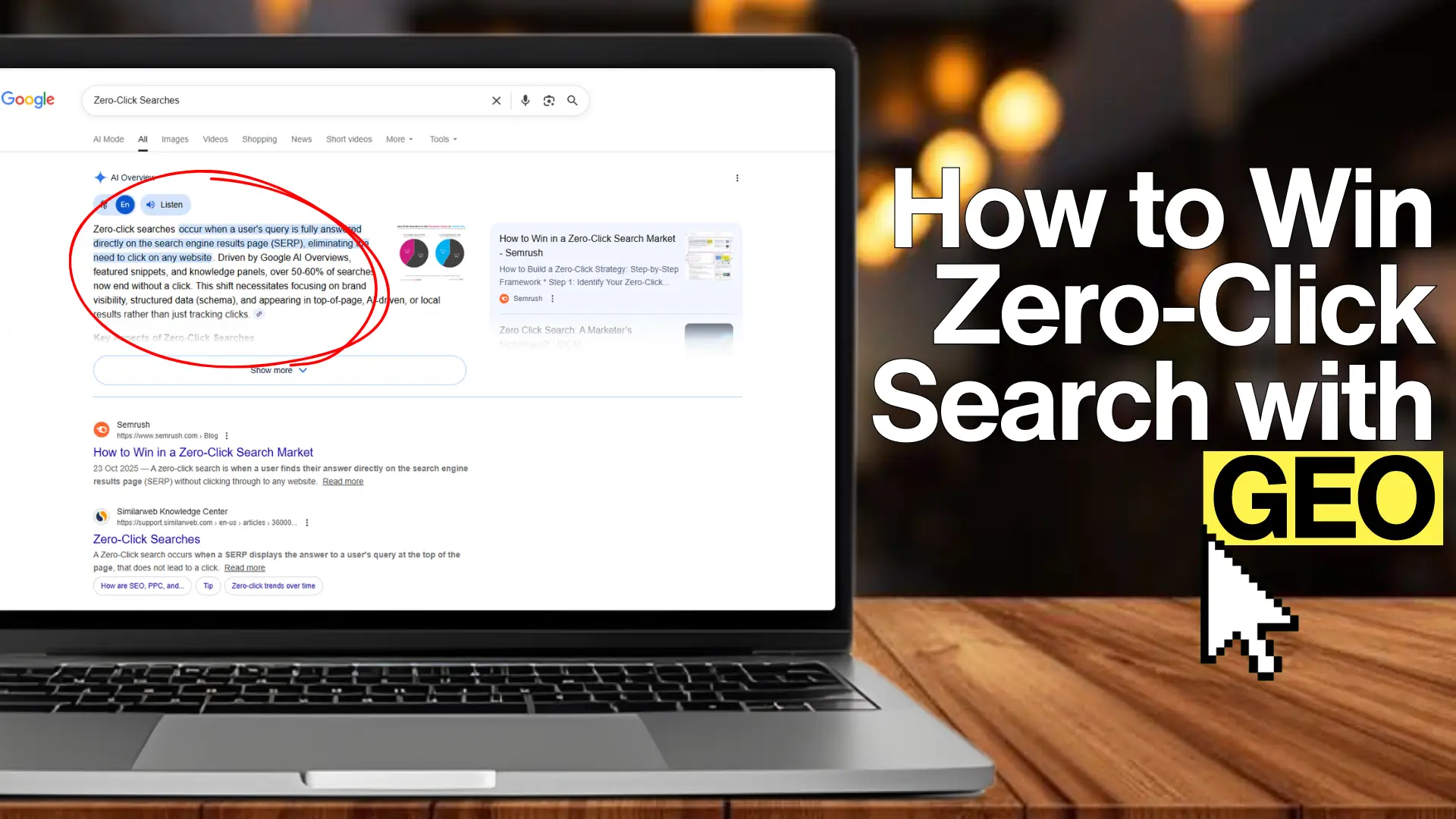
Zero-Click Searches & GEO: The Future of SEO in an Answer-First World
The way people search online has undergone a major transformation, driven largely by the rise of zero click searches. For years, businesses concentrated on improving rankings, increasing clicks, and driving website traffic. Today, however, users can find answers instantly,without ever clicking on a link.
More than 60% of Google searches now end without a click. Users get the information they need directly from search results or AI-powered tools, eliminating the need to visit external websites. This shift has left many marketers puzzled, especially when rankings remain stable but traffic declines.
The reality is clear: SEO isn’t failing,the way we measure success is evolving.
What Are Zero-Click Searches?
Zero-click searches occur when a user’s query is answered directly within the search interface. This can happen through:
-
Featured snippets
-
Knowledge panels
-
Local packs
-
AI-generated summaries
-
Chatbot responses
Instead of navigating through multiple websites, users receive quick, precise answers instantly. The search journey begins and ends within the same interface.
Research indicates that 80% of users rely on zero-click results nearly 40% of the time. This trend reflects not a limitation, but a shift toward efficiency and convenience.
Why Zero-Click Searches Are Increasing
Modern search engines and AI tools are built to minimize effort and maximize speed.
Their goals include:
-
Providing immediate answers
-
Keeping users within their ecosystem
-
Delivering accurate and useful information quickly
For instance, a simple search for a live match score now displays real-time results, highlights, and context—without requiring any clicks.
This signals a fundamental shift: users are no longer exploring,they are solving.
From Keywords to Entities: A New Search Approach
Traditional SEO revolved around keywords and rankings. Today, search has become more entity-driven, focusing on meaning, context, and user intent rather than exact keyword matches.
Search engines and AI systems now:
-
Understand user queries
-
Combine information from multiple sources
-
Deliver direct, synthesized answers
This evolution brings together:
-
SEO
-
AI-generated summaries
-
Chatbots
-
Generative responses
The Shift from Reading to Scanning
User behavior has dramatically changed over time.
Previously, users would:
-
Click on multiple links
-
Read long-form content
-
Spend time researching
Now, users:
-
Scan summaries quickly
-
Look for direct answers
-
Spend only a few seconds per query
Studies show that only 8–9% of users click on links after seeing a summary.
AI platforms are designed to support this behavior by offering:
-
Bullet points
-
Clear conclusions
-
Step-by-step explanations
-
Concise insights
As a result, traditional browsing is becoming less relevant.
Search Engines Have Become Endpoints
In the past, search engines acted as intermediaries, directing users to websites. Their success depended on sending traffic outward.
Today, they function as endpoints.
Modern systems:
-
Instantly resolve user intent
-
Reduce dependence on external links
-
Keep users within the platform
AI tools take this further by not just ranking content,but selecting and generating answers. This explains why traffic may drop even when rankings remain unchanged.
The Rise of Generative Engine Optimization (GEO)
As search evolves, so must optimization strategies. This is where Generative Engine Optimization (GEO) comes into play.
GEO focuses on optimizing content so AI tools can:
-
Cite it
-
Summarize it
-
Use it as a trusted reference
Unlike traditional SEO, which emphasizes rankings, GEO aims to make your content the source of truth for AI-generated answers.
This shift matters because:
-
AI systems prioritize structured and reliable content
-
They favor clarity and consistency
-
They reuse content that is easy to interpret
Simply put: if your content isn’t extractable, it won’t be cited.
Why Traditional Metrics Are Losing Relevance
For years, SEO success was measured using:
-
Click-through rate (CTR)
-
Page views
-
Bounce rate
However, in a zero-click environment, these metrics are becoming outdated.
Users may:
-
See your content
-
Trust your insights
-
Never visit your site
This creates a gap between visibility and actual traffic.
New Metrics for the AI-Driven Era
To stay relevant, businesses must adopt new performance indicators:
1. Impressions
Visibility matters more than clicks. Frequent appearances mean influence.
2. AI Citations
When AI tools reference your content, it signals credibility.
3. Share of Model (SoM)
Measures how often your brand appears in AI-generated answers.
4. Brand Search Growth
Indicates brand recall and awareness.
5. SERP Feature Presence
Includes visibility in snippets, panels, and AI summaries.
6. Assisted Conversions
Tracks indirect influence on user decisions.
Success is no longer about clicks,it’s about recognition and trust.
Building Authority Without Traffic
Authority in the digital space is being redefined.
Earlier, it depended on:
-
Website visits
-
Backlinks
-
Engagement metrics
Now, authority is built when:
-
AI systems reuse your content
-
Your insights are cited
-
Your frameworks are referenced
Even without direct visits, users can still remember and trust your brand. This is known as authority without traffic.
AEO + GEO: The Future of Search Optimization
Answer Engine Optimization (AEO) and GEO together represent the next phase of SEO.
AEO focuses on:
-
Delivering direct answers
-
Optimizing for search engine responses
GEO focuses on:
-
Structuring content for AI systems
-
Ensuring clarity and reusability
AI systems prioritize content that is:
-
Clear
-
Logical
-
Consistent
-
Easy to interpret
This combination helps brands:
-
Influence decisions earlier
-
Build trust before engagement
-
Maintain visibility in AI-driven platforms
How to Optimize for Zero-Click Searches
To succeed in this evolving landscape, content must be structured differently.
1. Target Zero-Click Queries
Focus on informational and quick-answer queries.
2. Analyze Existing Results
Study AI summaries and featured snippets.
3. Structure for Clarity
Use headings, short paragraphs, and logical flow.
4. Create Modular Content
Ensure sections can stand alone for reuse.
5. Build Brand Naturally
Focus on clarity rather than aggressive promotion.
The Future of SEO: Optimize for Truth
The era of optimizing purely for clicks is coming to an end.
Today:
-
Influence comes before interaction
-
Trust is built before visits
-
Content must earn its place in AI systems
Zero-click searches don’t reduce the value of content,they increase the standard.
To succeed, businesses must:
-
Focus on accuracy
-
Build authority
-
Create AI-friendly content
Because in this new era, your goal is not just to attract clicks.
Your goal is to become the answer.
Categorías
Read More
" According to the latest report published by Data Bridge Market Research, the Mirtazapine Drug Market The global mirtazapine drug market size was valued at USD 1.21 billion in 2025 and is expected to reach USD 1.78 billion by 2033, at a CAGR of 5.00% during the forecast period Mirtazapine Drug Market report is a great option to achieve current as...

บทนำ ชีวิตมักนำเสนอสถานการณ์ที่ข้อเท็จจริงเป็นเรื่องยากที่จะเปิดเผย และความไม่แน่นอนทำให้เกิดความเครียด ความสับสน และความสงสัย ไม่ว่าจะเกี่ยวข้องกับความสัมพันธ์ส่วนตัว ข้อพิพาททางธุรกิจ คนหาย การสืบสวนการฉ้อโกง หรือประเด็นทางกฎหมาย การเข้าถึงข้อมูลที่ถูกต้องสามารถสร้างความแตกต่างได้ นี่คือจุดที่นักสืบมืออาชีพมีบทบาทสำคัญ บริการสืบสวนสมัยใหม่ผสมผสานประสบการณ์ ความรู้ทางกฎหมาย เทคโนโลยีขั้นสูง...

The latest Harry Potter audiobook series boasts an impressive full cast, bringing the beloved characters vividly to life through a diverse array of talented voice actors. From the wise guidance of Albus Dumbledore to the distinctive voices of the Dursley family, each character is uniquely portrayed, adding depth and richness to the listening experience. Scheduled to launch on November 4th, the...

The IPL 2026 season continues to excite cricket fans, and the upcoming clash between Kolkata Knight Riders (KKR) and Punjab Kings (PBKS) is set to be a thrilling contest. With both teams featuring explosive players, users are actively searching for the best KKR vs PBKS IPL 2026 Mahadev Book ID insights to enhance their match predictions and strategies. Using platforms like Mahadev Book, players...

Online betting has become an increasingly popular form of digital entertainment, giving users the opportunity to explore different sports and betting markets from online platforms. Mahadev Book is a betting site associated with this growing online space, offering a platform where users can explore available betting options through a digital interface. Understanding Mahadev Book Mahadev Book is...
