Zero-Click Searches & GEO: How to Stay Visible When No One Clicks
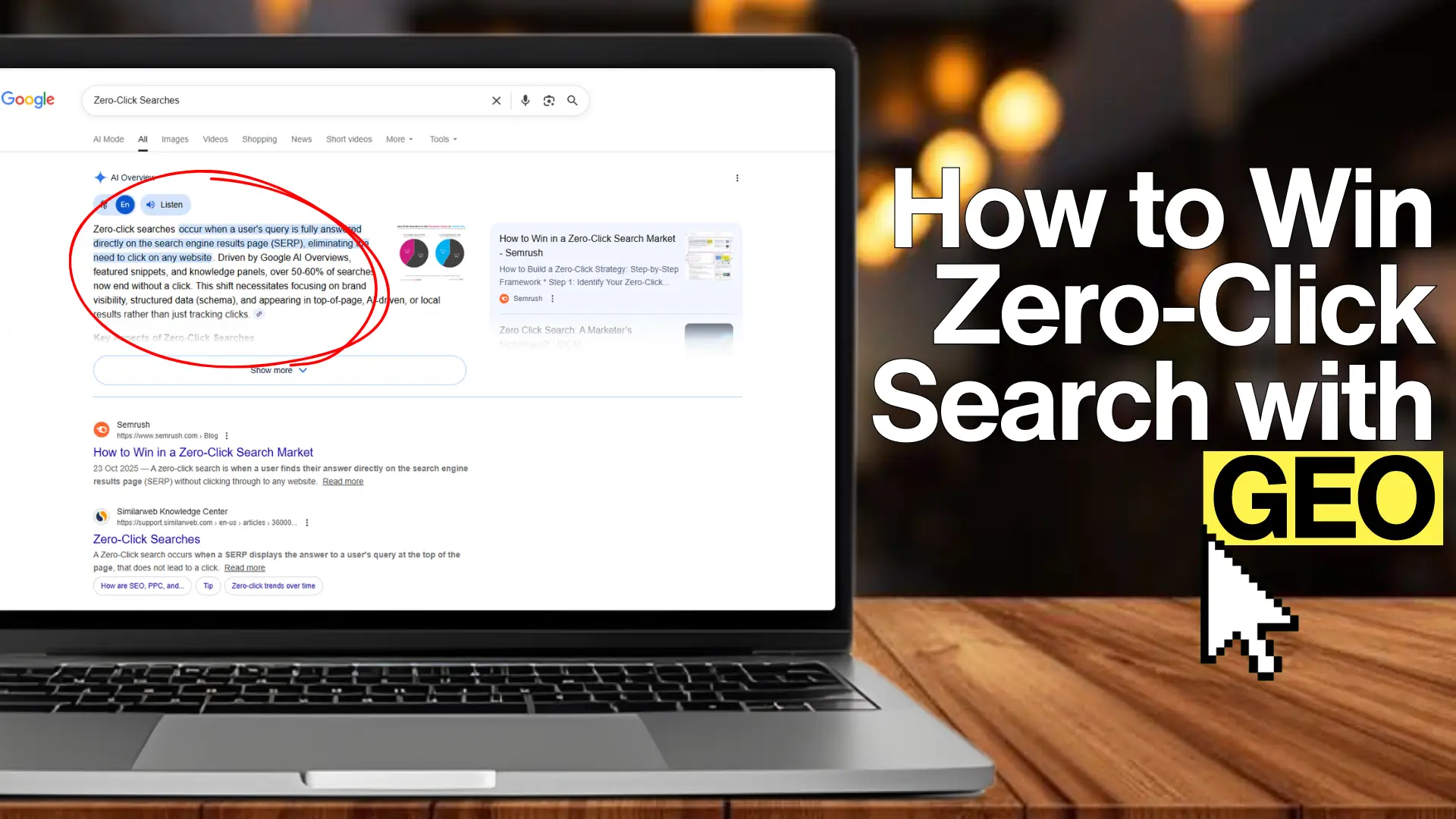
Zero-Click Searches & GEO: The Future of SEO in an Answer-First World
The way people search online has undergone a major transformation, driven largely by the rise of zero click searches. For years, businesses concentrated on improving rankings, increasing clicks, and driving website traffic. Today, however, users can find answers instantly,without ever clicking on a link.
More than 60% of Google searches now end without a click. Users get the information they need directly from search results or AI-powered tools, eliminating the need to visit external websites. This shift has left many marketers puzzled, especially when rankings remain stable but traffic declines.
The reality is clear: SEO isn’t failing,the way we measure success is evolving.
What Are Zero-Click Searches?
Zero-click searches occur when a user’s query is answered directly within the search interface. This can happen through:
-
Featured snippets
-
Knowledge panels
-
Local packs
-
AI-generated summaries
-
Chatbot responses
Instead of navigating through multiple websites, users receive quick, precise answers instantly. The search journey begins and ends within the same interface.
Research indicates that 80% of users rely on zero-click results nearly 40% of the time. This trend reflects not a limitation, but a shift toward efficiency and convenience.
Why Zero-Click Searches Are Increasing
Modern search engines and AI tools are built to minimize effort and maximize speed.
Their goals include:
-
Providing immediate answers
-
Keeping users within their ecosystem
-
Delivering accurate and useful information quickly
For instance, a simple search for a live match score now displays real-time results, highlights, and context—without requiring any clicks.
This signals a fundamental shift: users are no longer exploring,they are solving.
From Keywords to Entities: A New Search Approach
Traditional SEO revolved around keywords and rankings. Today, search has become more entity-driven, focusing on meaning, context, and user intent rather than exact keyword matches.
Search engines and AI systems now:
-
Understand user queries
-
Combine information from multiple sources
-
Deliver direct, synthesized answers
This evolution brings together:
-
SEO
-
AI-generated summaries
-
Chatbots
-
Generative responses
The Shift from Reading to Scanning
User behavior has dramatically changed over time.
Previously, users would:
-
Click on multiple links
-
Read long-form content
-
Spend time researching
Now, users:
-
Scan summaries quickly
-
Look for direct answers
-
Spend only a few seconds per query
Studies show that only 8–9% of users click on links after seeing a summary.
AI platforms are designed to support this behavior by offering:
-
Bullet points
-
Clear conclusions
-
Step-by-step explanations
-
Concise insights
As a result, traditional browsing is becoming less relevant.
Search Engines Have Become Endpoints
In the past, search engines acted as intermediaries, directing users to websites. Their success depended on sending traffic outward.
Today, they function as endpoints.
Modern systems:
-
Instantly resolve user intent
-
Reduce dependence on external links
-
Keep users within the platform
AI tools take this further by not just ranking content,but selecting and generating answers. This explains why traffic may drop even when rankings remain unchanged.
The Rise of Generative Engine Optimization (GEO)
As search evolves, so must optimization strategies. This is where Generative Engine Optimization (GEO) comes into play.
GEO focuses on optimizing content so AI tools can:
-
Cite it
-
Summarize it
-
Use it as a trusted reference
Unlike traditional SEO, which emphasizes rankings, GEO aims to make your content the source of truth for AI-generated answers.
This shift matters because:
-
AI systems prioritize structured and reliable content
-
They favor clarity and consistency
-
They reuse content that is easy to interpret
Simply put: if your content isn’t extractable, it won’t be cited.
Why Traditional Metrics Are Losing Relevance
For years, SEO success was measured using:
-
Click-through rate (CTR)
-
Page views
-
Bounce rate
However, in a zero-click environment, these metrics are becoming outdated.
Users may:
-
See your content
-
Trust your insights
-
Never visit your site
This creates a gap between visibility and actual traffic.
New Metrics for the AI-Driven Era
To stay relevant, businesses must adopt new performance indicators:
1. Impressions
Visibility matters more than clicks. Frequent appearances mean influence.
2. AI Citations
When AI tools reference your content, it signals credibility.
3. Share of Model (SoM)
Measures how often your brand appears in AI-generated answers.
4. Brand Search Growth
Indicates brand recall and awareness.
5. SERP Feature Presence
Includes visibility in snippets, panels, and AI summaries.
6. Assisted Conversions
Tracks indirect influence on user decisions.
Success is no longer about clicks,it’s about recognition and trust.
Building Authority Without Traffic
Authority in the digital space is being redefined.
Earlier, it depended on:
-
Website visits
-
Backlinks
-
Engagement metrics
Now, authority is built when:
-
AI systems reuse your content
-
Your insights are cited
-
Your frameworks are referenced
Even without direct visits, users can still remember and trust your brand. This is known as authority without traffic.
AEO + GEO: The Future of Search Optimization
Answer Engine Optimization (AEO) and GEO together represent the next phase of SEO.
AEO focuses on:
-
Delivering direct answers
-
Optimizing for search engine responses
GEO focuses on:
-
Structuring content for AI systems
-
Ensuring clarity and reusability
AI systems prioritize content that is:
-
Clear
-
Logical
-
Consistent
-
Easy to interpret
This combination helps brands:
-
Influence decisions earlier
-
Build trust before engagement
-
Maintain visibility in AI-driven platforms
How to Optimize for Zero-Click Searches
To succeed in this evolving landscape, content must be structured differently.
1. Target Zero-Click Queries
Focus on informational and quick-answer queries.
2. Analyze Existing Results
Study AI summaries and featured snippets.
3. Structure for Clarity
Use headings, short paragraphs, and logical flow.
4. Create Modular Content
Ensure sections can stand alone for reuse.
5. Build Brand Naturally
Focus on clarity rather than aggressive promotion.
The Future of SEO: Optimize for Truth
The era of optimizing purely for clicks is coming to an end.
Today:
-
Influence comes before interaction
-
Trust is built before visits
-
Content must earn its place in AI systems
Zero-click searches don’t reduce the value of content,they increase the standard.
To succeed, businesses must:
-
Focus on accuracy
-
Build authority
-
Create AI-friendly content
Because in this new era, your goal is not just to attract clicks.
Your goal is to become the answer.
Categorieën
Read More
Get healthier and glowing skin with the best skincare treatment offered by the experts at Uptown Med Spa Oakville. The latest techniques are used in their skincare treatment packages which can rejuvenate, repair, and improve your skin quality in the most natural way possible. Whether it is acne, fine lines, uneven skin tones, and dry skin, we have the right techniques for all types of skins....

The global Impulse Dosing Valves Market is experiencing significant expansion as modern industries transition toward automation and ultra-precision fluid management. Impulse dosing valves have become critical components across various complex setups where exact fluid volumes must be dispensed at highly precise, micro-second intervals without product degradation. Industrial automation demands...
The latest update for Valorant, version 11.05, introduces a series of refinements aimed at enhancing gameplay and ensuring fair play. Riot Games has implemented stricter penalties for players who engage in AFK queue dodging and remaking, targeting disruptive behavior and promoting a more competitive environment. This summer marks a significant milestone for Valorant, celebrating its fifth...
The global housing landscape is undergoing a significant transformation as affordability and sustainability become the primary drivers of consumer choice. The manufactured housing market, once a niche segment, has emerged as a powerhouse in the construction industry. According to the latest research by The Insight Partners, the Manufactured Housing...

"Executive Summary Asia-Pacific Silicone Surfactants Market Size and Share: Global Industry Snapshot Data Bridge Market Research analyses that the Asia-Pacific silicone surfactants market is expected to reach a value of USD 1,517,671.05 thousand by 2030, at a CAGR of 6.0% during the forecast period. This Asia-Pacific Silicone Surfactants Market report involves the drivers and...