


Solving Rigidity Issues in Robotic Cross Roller Bearings
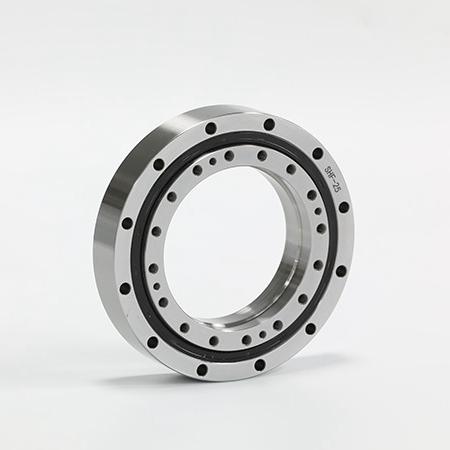
Maintaining sub-micron accuracy in robotic joints becomes impossible when your bearings lack the necessary rigidity. I often see B2B engineers struggling with "play" that develops after only a few months of heavy-duty operation.
Standard ball bearings frequently fail under tilting moments because they cannot distribute stress across a wide enough surface area. This leads to jerky movements and rapid wear, which eventually halts your entire production line.
Switching to a crossed design solves these torque issues by handling radial, axial, and moment loads simultaneously. As a manufacturer, I recommend this path for any application requiring high stiffness within a compact space.
The Root Cause of Positioning Errors
In the world of automated manufacturing and CNC rotary tables, a cross roller bearing is the backbone of precision. However, many B2B procurement teams face a recurring problem: displacement under load. When a robotic arm extends, the bearing at the base experiences a massive "tilting moment." If the bearing isn't stiff enough, the arm "droops," leading to failed quality checks and wasted materials.
Unlike traditional bearings that use spherical balls, crossed rollers use cylindrical rollers arranged at 90-degree angles to each other. This creates a "line contact" rather than a "point contact," which significantly increases the load-carrying capacity and eliminates the elastic deformation that causes positioning errors.
Managing Internal Clearance and Preload
One of the most common issues we see in industrial maintenance is the "chatter" or vibration during high-speed rotation. This is almost always caused by improper internal clearance.
-
Negative Clearance (Preload): Essential for high-precision tasks. It ensures no "gap" exists between the rollers and the raceway, maximizing stiffness.
-
Positive Clearance: Only used in applications where thermal expansion is extreme and high speed is more important than absolute accuracy.
If your machinery is losing accuracy over time, it is likely that the preload has diminished due to wear or poor installation. Ensuring that the mounting bolts are torqued to exact specifications is vital to maintaining the structural integrity of the split inner or outer rings.
Reducing Friction and Heat in Compact Designs
Because cross roller bearings are often used in compact environments—like medical equipment or semiconductor manufacturing—heat dissipation is a major hurdle. If the rollers are packed too tightly without a proper spacer or "separator," friction increases exponentially.
High-quality models utilize a specialized spacer between each individual roller. This prevents "skewing" (where a roller tilts out of alignment) and reduces the friction that leads to overheating. For B2B buyers, verifying the material of these spacers—whether industrial resin or brass—can be the difference between a bearing that lasts five years and one that fails in six months.
Solving the Contamination Challenge
In heavy industrial environments, dust and metallic shavings are the primary enemies of precision. Because these bearings have a large surface area for the rollers, even a tiny particle can cause "brinelling" (permanent indentations in the raceway).
-
Integrated Seals: Always opt for models with built-in rubber seals if your environment is not 100% clean.
-
Grease Nipple Placement: Ensure your housing design allows for easy re-lubrication. Fresh grease not only lubricates but also pushes out any microscopic debris that has managed to enter the raceway.
Optimized Mounting for Maximum Service Life
The way you mount these components dictates their lifespan. Because many crossed roller designs feature a split ring (either the inner or outer), the housing must provide even support. If the housing bore is "out-of-round" by even a few microns, it will squeeze the bearing unevenly, leading to hot spots and premature fatigue.
Using a high-precision ground housing and ensuring the mounting surface is perfectly flat is non-negotiable for high-end B2B applications. This allows the bearing to perform at its rated P2 or P4 precision levels without being hampered by external mechanical flaws.
Conclusion
As a dedicated manufacturer and supplier, Yuwei Bearing provides high-rigidity cross roller solutions that eliminate downtime. Trust our factory-direct expertise for your precision needs.
Категории
Больше
The data broker industry, long a bastion of established practices, is currently being rocked by a series of transformative and disruptive Data Broker Market Trends. The most significant and far-reaching trend is the global wave of data privacy legislation and the corresponding consumer backlash against invasive tracking. Regulations like the EU's General Data Protection Regulation (GDPR)...

Maintaining a positive attitude throughout exam preparation contributes significantly to success. Challenges and setbacks are normal parts of the learning process. A comprehensive Exam Study Material Exam Study Guide reminds students to celebrate progress, remain consistent, and continue improving even after encountering difficult topics. Persistence combined with quality Exam Study Material...

The value of trust cannot be overstated in modern business. Consumers increasingly research brands before making purchasing decisions. Press releases published on respected websites Buy Press Release contribute to a positive online presence and demonstrate a company's commitment to transparency. As customers encounter credible news coverage and official company announcements, their...

The Russia flat steel market is undergoing a substantial transformation, with projections indicating a market size of approximately 14.6 billion USD by 2035. This growth signals a compound annual growth rate (CAGR) of 10.503%, emphasizing the increasing significance of steel in various industrial applications. The dynamic shift is attributed to advancements in technology and a robust push for...

Trong thời đại công nghệ số phát triển mạnh mẽ, nhu cầu giải trí trực tuyến ngày càng trở nên phổ biến. Người dùng không chỉ tìm kiếm các trò chơi hấp dẫn mà còn mong muốn một nền tảng ổn định, dễ sử dụng và có nhiều lựa chọn thú vị.SC88 ra đời nhằm đáp ứng những nhu...