Aviation Career Guide: Where to Enroll, What to Study, and How to Become a Pilot in India
If you’re thinking about building an aviation career, you’ve probably come across a lot of confusing advice. Some say you need a degree, others talk about flight schools, and many don’t clearly explain the actual path.
Let’s simplify everything in one place so you can understand where to enroll, what to study, and how to move step by step toward becoming a pilot.
First, understand what you want in aviation
“Aviation” is a broad field. Before choosing a course, ask yourself:
- Do you want to fly aircraft?
- Do you want a technical role (like engineering)?
- Do you want a management or airport job?
If your answer is flying, then your focus should be on becoming a pilot, not just doing a general aviation course.
The actual path to becoming a pilot
Becoming a pilot in India is not about getting a degree. It’s about getting a license.
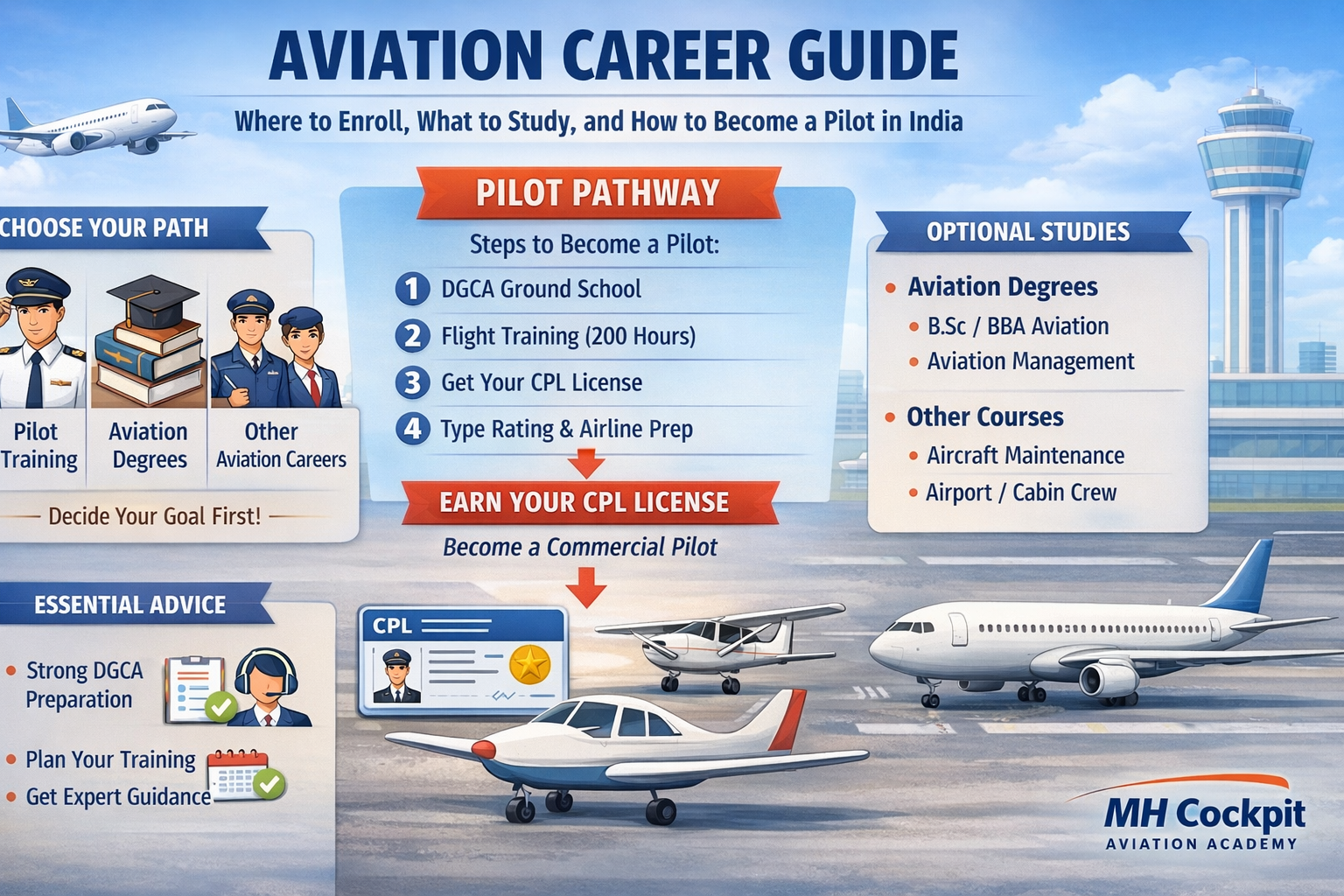
Here’s the real roadmap:
- Complete 12th with Physics and Mathematics
- Join a ground school and clear DGCA exams
- Complete flying training (200 hours)
- Get your CPL (Commercial Pilot License)
- Do type rating and prepare for airlines
This is the core journey. Everything else is optional.
Where should you enroll?
If your goal is to become a pilot, you typically enroll in two types of places:
1. Ground schools
These help you:
- Understand DGCA subjects
- Build strong fundamentals
- Prepare for exams
For example, MH Cockpit focuses on:
- DGCA ground training
- Explaining aviation concepts clearly
- Helping students understand the full pilot pathway
This stage is important because many students struggle later due to weak basics.
2. Flying schools
This is where you:
- Complete your flying hours
- Gain real cockpit experience
- Work toward your CPL
What about aviation degrees?
Courses like:
- BSc Aviation
- BBA Aviation
- Aviation Management
are available in colleges and universities.
But here’s the key point:
These degrees do not make you a pilot
They can be useful as a backup or for general knowledge, but your career as a pilot depends on your license and training, not your degree.
Other aviation career options
If you’re not fully sure about flying, aviation also offers:
- Aircraft Maintenance Engineering (AME)
- Airport Management
- Cabin Crew
Each has its own path and requirements, so it’s important not to confuse them with pilot training.
Why proper guidance matters
One of the biggest mistakes students make is jumping into courses without understanding the full journey.
This often leads to:
- Delays in training
- Extra costs
- Confusion after CPL
That’s why starting with the right guidance is important. Training platforms like MH Cockpit help students:
- Understand the complete roadmap
- Build strong basics
- Avoid common mistakes
Timeline and expectations
After 12th, becoming a pilot usually takes:
- 18–24 months (fast track)
- 2–3 years (normal pace)
Delays mostly happen due to poor planning or weak preparation, not because the path itself is unclear.
Final thoughts
Aviation can look complicated from the outside, but once you understand the structure, it becomes much clearer.
- You don’t need a specific college
- You don’t need a fancy degree
- You need the right training, exams, and planning
If your goal is to fly, focus on the CPL pathway, build strong fundamentals, and choose your training wisely.
Because in aviation, success doesn’t come from where you enroll, it comes from how well you prepare for the journey ahead.
الأقسام
إقرأ المزيد
The Biopellet Energy Market is emerging as one of the most dynamic segments in the global renewable energy landscape. With increasing urgency around decarbonization, advancing pellet technologies, and supportive regulatory frameworks worldwide, biopellets are no longer a niche fuel — they are rapidly becoming a mainstream sustainable energy solution. According to the latest...

Building an email list from scratch may sound difficult especially if you’re not using paid ads. But the truth is, many successful businesses and every smart digital marketing agency know that organic list building is not only possible, but also more sustainable and high-quality. If you’re just starting out, this guide will help you understand exactly how to grow your email list...

Using AOL Mail Login, you receive a email service that's packed with intuitive capabilities. It includes features like spam filter, and unmatched storage area, simple to use interface, cellular access and highly personalized service. Together with that, it's highly organized. To put it differently, it manages your emails effectively. aol mailaol mail

"Folliculitis Market Summary: According to the latest report published by Data Bridge Market Research, the Folliculitis Market The global folliculitis market size was valued at USD 1.98 billion in 2024 and is expected to reach USD 3.12 billion by 2028, growing at a CAGR of 5.81% during the forecast period. Folliculitis Market report is a great option to...
The comedic world of Eurovision expands with a stellar new cast addition. Katiana, a vocal powerhouse from Iceland, will be brought to life by Demi Lovato. She enters a lineup featuring Will Ferrell and Rachel McAdams as the ambitious duo Lars and Sigrit. Pierce Brosnan embodies the formidable charm of Lars' father, Erick. Dan Stevens joins the fray as Alexander Lemtov, a formidable Russian...