Aviation Career Guide: Where to Enroll, What to Study, and How to Become a Pilot in India
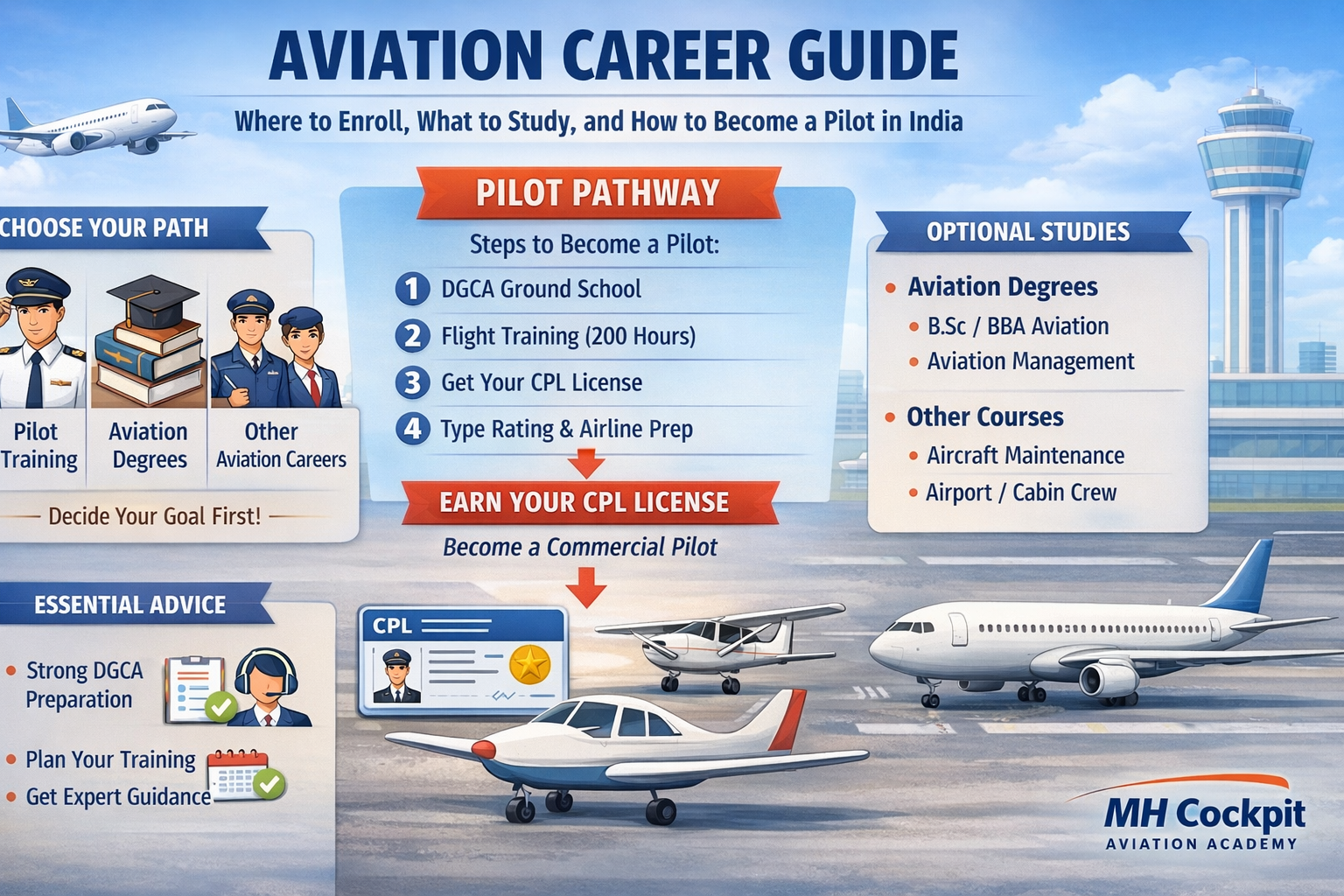
If you’re thinking about building an aviation career, you’ve probably come across a lot of confusing advice. Some say you need a degree, others talk about flight schools, and many don’t clearly explain the actual path.
Let’s simplify everything in one place so you can understand where to enroll, what to study, and how to move step by step toward becoming a pilot.
First, understand what you want in aviation
“Aviation” is a broad field. Before choosing a course, ask yourself:
- Do you want to fly aircraft?
- Do you want a technical role (like engineering)?
- Do you want a management or airport job?
If your answer is flying, then your focus should be on becoming a pilot, not just doing a general aviation course.
The actual path to becoming a pilot
Becoming a pilot in India is not about getting a degree. It’s about getting a license.
Here’s the real roadmap:
- Complete 12th with Physics and Mathematics
- Join a ground school and clear DGCA exams
- Complete flying training (200 hours)
- Get your CPL (Commercial Pilot License)
- Do type rating and prepare for airlines
This is the core journey. Everything else is optional.
Where should you enroll?
If your goal is to become a pilot, you typically enroll in two types of places:
1. Ground schools
These help you:
- Understand DGCA subjects
- Build strong fundamentals
- Prepare for exams
For example, MH Cockpit focuses on:
- DGCA ground training
- Explaining aviation concepts clearly
- Helping students understand the full pilot pathway
This stage is important because many students struggle later due to weak basics.
2. Flying schools
This is where you:
- Complete your flying hours
- Gain real cockpit experience
- Work toward your CPL
What about aviation degrees?
Courses like:
- BSc Aviation
- BBA Aviation
- Aviation Management
are available in colleges and universities.
But here’s the key point:
These degrees do not make you a pilot
They can be useful as a backup or for general knowledge, but your career as a pilot depends on your license and training, not your degree.
Other aviation career options
If you’re not fully sure about flying, aviation also offers:
- Aircraft Maintenance Engineering (AME)
- Airport Management
- Cabin Crew
Each has its own path and requirements, so it’s important not to confuse them with pilot training.
Why proper guidance matters
One of the biggest mistakes students make is jumping into courses without understanding the full journey.
This often leads to:
- Delays in training
- Extra costs
- Confusion after CPL
That’s why starting with the right guidance is important. Training platforms like MH Cockpit help students:
- Understand the complete roadmap
- Build strong basics
- Avoid common mistakes
Timeline and expectations
After 12th, becoming a pilot usually takes:
- 18–24 months (fast track)
- 2–3 years (normal pace)
Delays mostly happen due to poor planning or weak preparation, not because the path itself is unclear.
Final thoughts
Aviation can look complicated from the outside, but once you understand the structure, it becomes much clearer.
- You don’t need a specific college
- You don’t need a fancy degree
- You need the right training, exams, and planning
If your goal is to fly, focus on the CPL pathway, build strong fundamentals, and choose your training wisely.
Because in aviation, success doesn’t come from where you enroll, it comes from how well you prepare for the journey ahead.
Categorias
Leia Mais
October 2025 Netflix Highlights October 2025 brings an exciting array of new content to Netflix, with several highly anticipated releases catching viewers' attention. Among the most notable additions is the gripping psychological thriller "The Woman in Cabin 10" featuring Keira Knightley in the lead role. Knightley portrays a determined journalist who finds herself entangled in a mysterious...

Top Web Development Company in Bangalore for High-Performance Websites | Oricmeta Introduction Have you ever landed on a website and instantly decided whether to stay or leave? That quick decision often comes down to design, speed, and usability. In today’s competitive digital landscape, your website acts like your business’s virtual handshake—it either builds trust or...
Finding the right tutor for your child has become one of the most important decisions for parents in today’s competitive academic environment. Whether a student needs personalised attention, structured learning, or support in challenging subjects, a skilled tutor can make a measurable difference in performance and confidence. With the growing demand for home tutor Delhi, parents...

Executive Summary Fruits and Vegetable Processing Enzymes Market Value, Size, Share and Projections CAGR Value Data Bridge Market Research analyses that the fruits and vegetable processing enzymes market was valued at USD 42.1 billion in 2021 and is expected to reach the value of USD 75.65 billion by 2029, at a CAGR of 7.60% during the forecast period of 2022 to 2029. The world class...

Netflix has forged a multi-year partnership with Sugar23, bringing founder Michael Sugar and production head Ashley Zalta into the streaming giant's creative ecosystem for feature film development. Under this arrangement, Netflix secures priority consideration for any theatrical projects Sugar23 wishes to bring to life. This collaboration marks an evolution of Sugar's existing ties with the...