


How to Scale Black Box Testing for Large Applications?
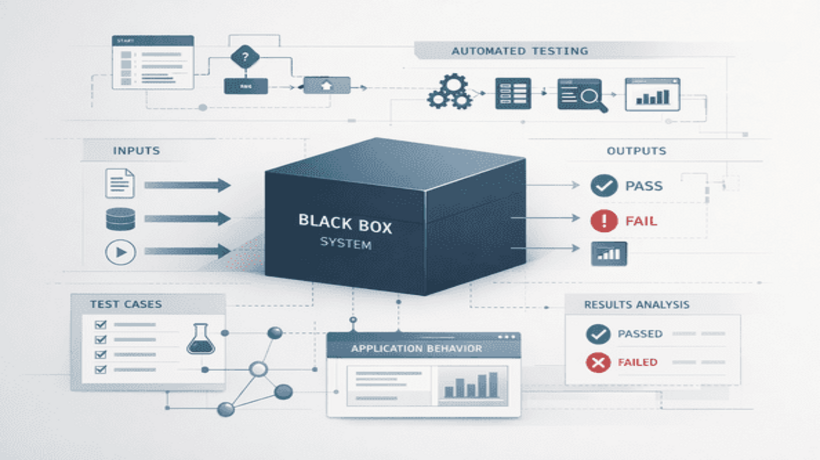
As applications grow in size and complexity, maintaining effective testing becomes increasingly challenging. Large systems often include multiple modules, integrations, and user workflows, making it difficult to ensure complete coverage. This is where scaling black box testing becomes essential.
By focusing on system behavior rather than internal implementation, black box testing helps teams validate functionality at scale. However, without the right strategy, it can quickly become inefficient and hard to manage.
Challenges of Scaling Black Box Testing
Before scaling, it’s important to understand the common challenges:
-
Rapid growth of test cases leading to longer execution times
-
Difficulty maintaining consistency across multiple modules
-
Increased risk of redundant or overlapping tests
-
Managing dependencies in distributed systems
-
Limited visibility into internal system behavior
Addressing these challenges requires a structured and strategic approach.
Prioritize Test Cases Based on Impact
Not all test cases are equally important in large applications. Focus on high-impact areas such as:
-
Core business workflows
-
Frequently used features
-
Critical integrations between services
Risk-based prioritization ensures that the most important functionalities are always validated, even as the test suite grows.
Use Modular Test Design
Breaking down test cases into smaller, reusable components improves scalability. Modular design allows teams to:
-
Reuse test logic across different scenarios
-
Reduce duplication in test scripts
-
Simplify maintenance and updates
This approach is particularly useful when dealing with black box testing for complex applications with shared functionalities.
Leverage Automation Strategically
Automation is key to scaling black box testing effectively. However, it must be applied thoughtfully:
-
Automate repetitive and stable test cases
-
Focus on API-level testing for faster execution
-
Avoid over-automation of frequently changing features
A balanced automation strategy ensures efficiency without increasing maintenance overhead.
Implement Parallel Test Execution
Running tests sequentially can significantly slow down large test suites. Parallel execution allows multiple tests to run simultaneously, reducing overall execution time.
Benefits include:
-
Faster feedback cycles
-
Better resource utilization
-
Improved pipeline efficiency
This is especially important for large applications with extensive regression requirements.
Integrate with CI/CD Pipelines
To scale effectively, black box testing must be integrated into CI/CD workflows. This enables:
-
Automated test execution on every code change
-
Early detection of defects
-
Continuous validation of application stability
Running smaller, high-priority test suites during commits and full suites at scheduled intervals helps balance speed and coverage.
Optimize Test Data Management
Large applications often require complex and dynamic test data. Poor data management can lead to inconsistent results and test failures.
Best practices include:
-
Using isolated and reusable datasets
-
Automating data setup and cleanup
-
Avoiding dependencies between test cases
Efficient data handling improves reliability and scalability.
Combine with Other Testing Approaches
While scaling black box testing, it’s important to complement it with other methods. Understanding the role of black box vs white box testing helps teams ensure both external behavior and internal logic are properly validated.
This combined approach provides deeper coverage and reduces the risk of hidden defects.
Monitor and Continuously Improve
Scaling is not a one-time effort. Teams should continuously monitor:
-
Test execution time
-
Failure rates and patterns
-
Coverage of critical workflows
Regular analysis helps identify bottlenecks and optimize the testing strategy over time.
Conclusion
Scaling black box testing for large applications requires more than just adding more test cases—it demands a strategic approach focused on prioritization, automation, modular design, and continuous improvement.
By integrating testing into CI/CD pipelines, leveraging parallel execution, and combining multiple testing approaches, teams can maintain efficiency while ensuring comprehensive validation. This enables faster releases, improved software quality, and a more reliable user experience in complex systems.
Categorii
Citeste mai mult
The Massive MIMO Market is witnessing exponential growth as telecom operators accelerate the deployment of advanced wireless technologies to support next-generation connectivity. The market was valued at USD 7.98 billion in 2025 and is projected to reach USD 151.20 billion by 2035, growing at a remarkable CAGR of 34.78% during the forecast period 2026–2035. Massive MIMO (Multiple Input,...

A new growth forecast report titled Low Alcohol Beverages Market Share, Size, Trends, Industry Analysis Report By Product Type (Beer, Wine, Spirit, and RTDs); By Distribution Channel; By Region; Segment Forecast, 2025 - 2034 introduced by Polaris Market Research represents conclusive data on the overall market. It majorly targets to provide a detailed analysis of growth factors,...

Komputer dan smartphone memungkinkan pengguna mendapatkan informasi kapan saja dan di mana saja. OLXTOTO, Toto Macau, Togel Macau, Data Toto Macau, serta Bandar Toto Macau merupakan kata kunci yang cukup populer di internet. Perkembangan teknologi internet membantu pengguna memperoleh informasi secara lebih efisien. Apa Itu OLXTOTO OLXTOTO merupakan salah satu istilah yang sering muncul dalam...

NEWARK, Del., August 3, 2026 — The global Lemon Juice Concentrate Market is projected to expand as beverage formulators, food processors, and foodservice operators increasingly seek standardized citrus inputs that provide consistent acidity, flavor delivery, storage efficiency, and easier batch control. According to Future Market Insights (FMI), the market is expected to grow from USD 1.5...

The market research for the global Postnatal Health Supplements market is an accumulation of first-hand facts and quantitative and qualitative evaluation and analysis for the forecast period (2024-2032). The report offers a comprehensive assessment of macro-economic indicators, parent market trends, and several factors influencing the market dynamics. In addition, it also...